
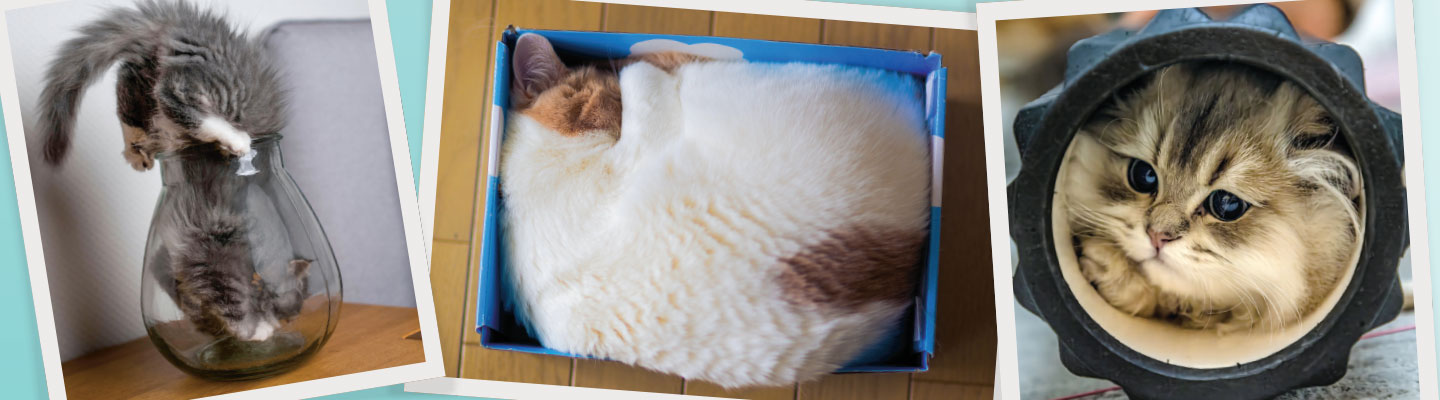

Three cats squeeze into small spaces: a glass vase, a cardboard box, and a round opening

Cats are able to contort their bodies to fit into tight spaces.

MAURITIUS IMAGES GMBH ALAMY STOCK PHOTO (VASE); BENJAMIN TORODE/GETTY IMAGES (BOX); KILITO CHAN/GETTY IMAGES (ROLLER)

STANDARDS

NGSS: Core Idea: LS2.C, LS4.D

CCSS: RI.2

TEKS: 6.5B, 7.5B, 8.5B, ENV.11A, ENV.11B

Standards

Are Cats Liquids?

Common sense tells us that cats are solids. But online photos of felines curled up in sinks, bowls, and vases have scientists wondering if cats are actually fluids.

ISTOCKPHOTO/GETTY IMAGES

Liquids match the shape of their container, right?

You can’t find your cat anywhere. He’s not in his bed, on his favorite window perch, or even under the sofa. Finally, you spot him. He’s lounging in the strangest place: squished into a glass bowl on the kitchen counter.

Cats love tight spaces. The internet is loaded with photos of kitties squeezing into tiny boxes, curling into jars, and wedging themselves into containers that look far too small. Cats seem to be able to “ooze” through the teensiest openings and contort to fill just about any vessel. This quirky behavior has led people online to jokingly ask: Are cats liquids? It might sound like a silly question. But cats actually appear to meet the classic definition of a liquid: A substance that flows freely and takes the shape of the container it’s in.

A few years ago, Marc-Antoine Fardin came across some of these cat memes. Fardin is a physicist at Lyon University in France who studies how matter flows and changes shape. He decided to apply his knowledge to cats, writing a scientific paper that humorously used physics principles to analyze the animals’ movements. According to Fardin, under the right conditions, cats really ARE liquids!

You can’t find your cat anywhere. He’s not in his bed, on his favorite window perch, or under the sofa. Finally, you spot him. Your cat is resting in the strangest place. He’s squished into a glass bowl on the kitchen counter.

Cats love tight spaces. The internet is loaded with photos of kitties squeezed into tiny boxes. Others are curled into jars or jammed into containers that look far too small. Cats seem to “ooze” through the tiniest openings. They contort to fill just about any vessel. This odd behavior has raised a question. People online are jokingly asking: Are cats liquids? It might sound silly. But cats actually seem to fit the classic definition of a liquid. It’s a substance that flows freely and takes the shape of its container.

A few years ago, Marc-Antoine Fardin saw some of these cat memes. Fardin is a physicist at Lyon University in France. He studies how matter flows and changes shape. He decided to apply his knowledge to cats. So Fardin wrote a humorous scientific paper. It used physics principles to analyze cats’ movements. Fardin says that under the right conditions, cats really ARE liquids!

ISTOCKPHOTO/GETTY IMAGES (TOP LEFT CAT); SHUTTERSTOCK.COM (TOP RIGHT CAT)

Cats have one of the twistiest spines in the animal kingdom!

PHASE CHANGERS

Matter is the “stuff” that makes up everything in the observable universe, from stars and cars to human beings. It has mass and takes up space. There are three common states of matter, or physical forms it can take: solid, liquid, and gas (see States of Matter, below). But some things don’t fit neatly into a single category.

“Sometimes a substance behaves like a solid, sometimes like a liquid, and sometimes it’s more complicated,” says Robert Campbell, a physicist at Northeastern University in Massachusetts. Think about ketchup: It changes shape to fit its container—but it doesn’t flow unless you give the bottle a good shake. It falls between a liquid and a solid, says Campbell. What about Greek yogurt? It holds its shape on a spoon . . . until you drop it into a bowl, SPLAT! Or take slime: It can ooze like a thick liquid, stretch like elastic, or bounce like a solid ball.

Cats are even more complicated. Because they move on their own, cats can quickly switch states, behaving more like a solid in one situation and a liquid in another. “That’s the cool thing about cats,” says Campbell. “They fit into different categories at different times.”

When Fardin decided to investigate whether cats were liquids, he noticed this too. When cats’ bodies are in motion, they maintain their shape—a defining property of a solid. But when relaxed, cats’ bodies often spread out to take the shape of the container they’re in—just like a liquid. Fardin proposed that the more quickly a cat settles into a container, which can vary based on the animal’s age and activity level, the more easily it can transform into a liquid.

Matter is the “stuff” of the observable universe. It makes up everything from stars and cars to human beings. It has mass and takes up space. Matter can take three common physical forms. These states of matter are solid, liquid, and gas (see States of Matter). But some things don’t fit neatly into one category.

“Sometimes a substance behaves like a solid, sometimes like a liquid, and sometimes it’s more complicated,” says Rob Campbell. He’s a physicist at Northeastern University in Massachusetts. Think about ketchup. It changes shape to fit its container. But it doesn’t flow unless you shake the bottle. It falls between a liquid and a solid, says Campbell. What about Greek yogurt? It holds its shape on a spoon. But when you drop it into a bowl, SPLAT! Or look at slime. It can ooze like a thick liquid. But it can also stretch like elastic or bounce like a solid ball.

Cats are even more complicated. They move on their own, so they can quickly switch states. They behave more like a solid in one situation. Then they act more like a liquid in another. “That’s the cool thing about cats,” says Campbell. “They fit into different categories at different times.”

When Fardin decided to study whether cats were liquids, he noticed this too. When cats’ bodies are in motion, they maintain their shape. That’s a property of a solid. But when cats relax in a container, their bodies often spread out to take its shape. That’s just like a liquid. A cat’s age and activity level affect how fast it settles into a container. Fardin proposed that the faster the cat settles, the more easily it transforms into a liquid.

NATURAL CONTORTIONISTS

So how exactly do cats become liquids? It turns out their unique anatomy gives them an advantage when it comes to fitting into tight spaces (see Cat Anatomy, below). For example, cats’ spines are designed to curve and twist, says Steve Lampa, a scientist who studies anatomy at Washington State University. Flexible discs between each vertebrae—the bones that make up the spine—provide cushioning. Humans have these discs too. “But in cats, they are even stretchier,” Lampa says.

Cats also have especially flexible shoulders that allow them to squeeze through tiny openings. A human’s shoulder bones are attached directly to the rest of their skeleton, limiting their range of motion. In cats, the shoulder bones are attached only to muscle, says Janelle Scott, a veterinarian at Colorado State University Veterinary Teaching Hospital. “That adaptation allows cats to pull their shoulders in so they can fit through narrow spaces.”

Finally, cats lack a tough, inflexible ligament to connect bones between their head and spine, Scott says. In humans, this ligament helps stabilize the neck. Not having it, says Scott, “gives cats flexibility so they can contort their head as they squeeze into small boxes.”

So how exactly do cats become liquids? Their unique anatomy helps them fit into tight spaces (see Cat Anatomy). For example, cats’ spines are designed to curve and twist, says Steve Lampa. He’s a scientist who studies anatomy at Washington State University. The bones that make up the spine are called vertebrae. Between each of them, flexible discs act as cushions. Humans have these discs too. “But in cats, they are even stretchier,” Lampa says.

Cats also have very flexible shoulders. This allows them to squeeze through tiny openings. A human’s shoulder bones are attached directly to the rest of their skeleton. That limits their range of motion. In cats, the shoulder bones are attached only to muscle, says Janelle Scott. She’s a veterinarian at Colorado State University Veterinary Teaching Hospital. “That adaptation allows cats to pull their shoulders in so they can fit through narrow spaces.”

Humans have a tough, inflexible ligament to help stabilize their neck. It connects bones between their head and spine. But cats don’t have this ligament. Scott says this “gives cats flexibility, so they can contort their head as they squeeze into small boxes.”

HIDING OUT

BENJAMIN TORODE/GETTY IMAGES

Cats’ superior flexibility makes them better at hunting and exploring.

A cat’s anatomy explains how they can fit into tight spaces. But why do they like squeezing into little containers in the first place? Today most cats live domesticated lives as people’s pets. But they were once wild predators—and sometimes still are, hunting backyard prey like lizards, mice, and birds. Concealing themselves in enclosed spaces helps kitties stay hidden while hunting. At the same time, exposed cats risk becoming prey themselves to larger, more fierce animals. In small spaces, cats are more protected, says Scott. They don’t have to worry about something sneaking up behind them. Instead, they only have to monitor the area in front of them for danger.

Scott is very familiar with the liquid-like characteristics of cats because she has two of her own: Salem and Sabrina. Recently, while unpacking from a trip, Scott left a suitcase out and set some things on top of it. “I thought that would keep them from getting in,” Scott says. “But they managed to paw open a small gap and squeeze inside!”

If you have a cat, what’s the most surprising place you’ve found your pet hiding?

Cats can fit into tight spaces because of their anatomy. But why do they like squeezing into little containers in the first place? Today most cats live domesticated lives as people’s pets. But they used to be wild predators. And sometimes they still are. Cats hunt backyard prey like lizards, mice, and birds. Kitties conceal themselves in enclosed spaces to stay hidden while hunting. At the same time, exposed cats are at risk. They could become prey to larger, more fierce animals. In small spaces, cats are more protected, says Scott. Nothing can sneak up behind them. They only have to watch for danger in front of them.

Scott is very familiar with the liquid-like behavior of cats. She has two of her own, named Salem and Sabrina. Recently, Scott was unpacking from a trip. She left a suitcase out and set some things on top of it. “I thought that would keep them from getting in,” Scott says. “But they managed to paw open a small gap and squeeze inside!”

If you have a cat, you’ve probably found your pet hiding. What was the most surprising place?

DR. JANELLE SCOTT

Send Us Your Pet Pics!

Check out Janelle Scott’s cats, Sabrina and Salem! Email photos of YOUR pet’s silliest behaviors to [email protected] by October 31. We’ll publish our favorites on the Science World website!

ARGUING FROM EVIDENCE:  Do you think cats qualify as liquids? Provide evidence from the article and paired diagrams to support your thinking.

videos (1)
Skills Sheets (3)
Skills Sheets (3)
Skills Sheets (3)
Quizzes (1)
Lesson Plan (2)
Lesson Plan (2)
Quizzes (1)
Text-to-Speech