
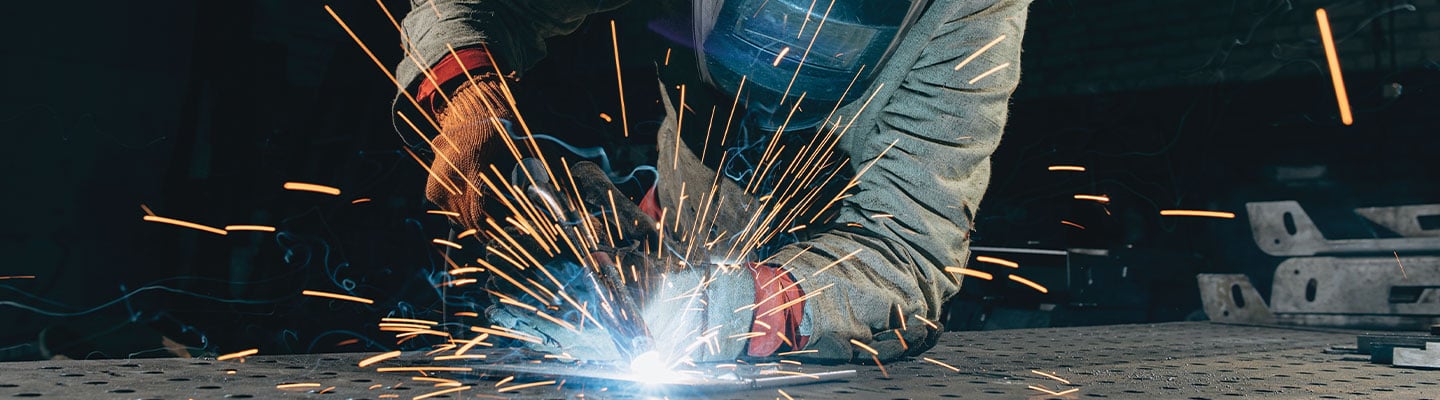

A welder in a helmet & gloves leans over a steel table as sparks fly from the bright weld

BREAKING BARRIERS: Only about 5 percent of welders in the U.S. are women.

SHUTTERSTOCK.COM

Standards

Professional Welder

Teia Moore fuses metal pieces to build everyday objects that last a lifetime.

UM PHOTOGRAPHY, E. BRONSON

“I love knowing the things I make are going to last a really long time.” —Teia Moore

The tip of a torch crackles with white-hot electricity. Sparks fly as Teia Moore uses the tool to bond two pieces of metal. She steps back, lifts her protective helmet, and admires her handiwork.

Moore works as a fabricator at a shop in Detroit, Michigan, where she assembles metal objects, like construction beams and stair handrails. The most intense part of her job is arc welding. Moore uses an electric current to fuse pieces of iron, steel, or aluminum by heating them past their melting points. Their temperatures can reach 5,500°C (10,000°F)—as hot as the sun’s surface!

Moore learned her trade through the Detroit-based organization Women Who Weld. It trains women to become welders, a profession  traditionally dominated by males. Moore spoke to Science World about why she loves this high-energy craft.

How did you get into welding?

One of my jobs after high school was at a stamping plant, using a large machine to fuse pieces of metal to make car parts. It was really repetitive. But every so often a welder would come in. I’d see him in the corner with his hood and torch, and it seemed really cool. I wanted to do that! A coworker told me about Women Who Weld, and I decided to apply and was accepted. After completing the program, I started working as a fabricator.

How does the fabrication process work?

All jobs start with a blueprint. That’s where engineers draw out the plan for what I’m going to make. I measure carefully and use big saws and grinders to cut pieces of metal into the shapes I need. Then I weld them together.

A welding machine is essentially a big sewing machine for piecing together metal. There’s a spool of wire that feeds into the torch I’m holding and comes out of the long end, like a needle.

When I turn the welding machine on, electricity runs through the needle and creates a circuit—or path electricity can flow through—between the pieces of metal I’m welding. This arc of electricity melts the wire and the metal pieces together, fusing them into one.

COURTESY OF TEIA MOORE

NICE JOB! Moore used her welding skills to create this set of metal stairs.

What are your favorite things to work on?

Right now, I specialize in building and welding metal handrails. They’re a really big part of everyone’s day. But most people don’t even realize that many handrails are custom-made. That means they have to be hand-welded. I love making them and thinking they’re going to be touched by so many hands.


How do you stay safe on the job?

Anytime you weld, sparks fly. It looks cool, but they’re really hot! To protect myself, I wear thick leather gloves and a fire-resistant welding jacket. A welding helmet protects my face and keeps the bright light of the arc from burning my eyes. It’s also important to remember that metal takes a long time to cool after you weld it, and you can get serious burns if you’re not careful. I can weld something, go eat lunch, and come back, and it’s still as hot as a cast iron skillet in the oven!

What are the biggest challenges in your work?

Welding is very male-dominated. I’ve been the only woman in every shop where I’ve worked, and I’ve faced harassment as a result. I’ve felt like I needed to work extra hard to prove that I know what I’m doing. But that hasn’t stopped me—and shouldn’t stop anyone else—from pursuing this career. I like working with my hands, and I like doing something that’s not expected of me. I love knowing the things I make are going to last a really long time.

videos (1)
Skills Sheets (2)
Skills Sheets (2)
Lesson Plan (1)
Text-to-Speech