
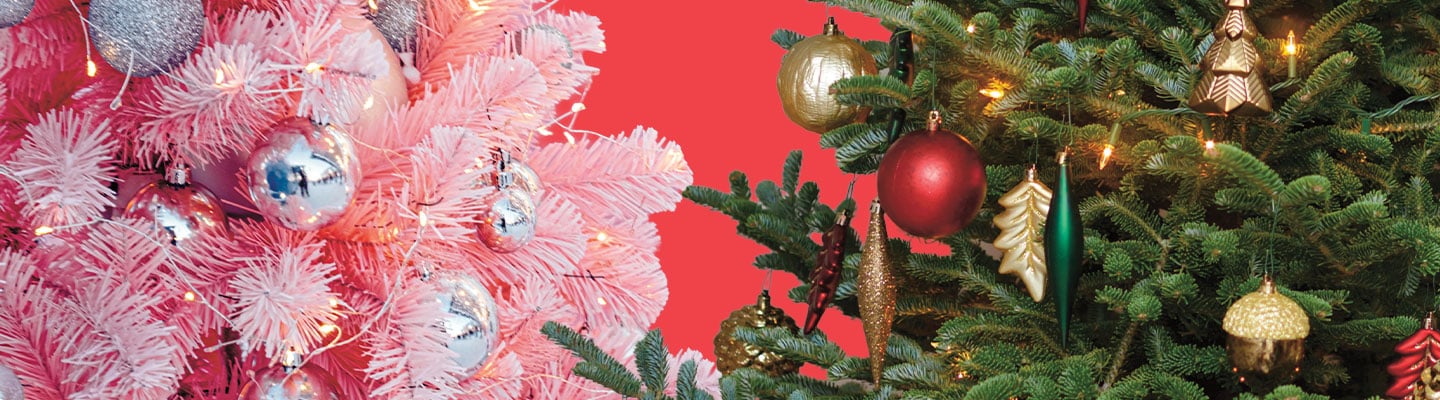

Composite image of a pink tree with silver baubles beside a green tree with gold & red ornaments

MILKY WAY/GETTY IMAGES (PINK TREE); SHUTTERSTOCK.COM (REAL TREE)

Standards

Real or Fake?

Experts weigh in on whether natural or artificial Christmas trees are better for the environment.

Which Tree Would You Pick?
Watch a video comparing real and fake Christmas Trees.

Five years ago, when Christopher Agee was 13 years old, a Facebook post caught his attention. A state park near his home in Birmingham, Alabama, was asking people to donate their real Christmas trees after the holidays. A wildlife center would use the trees as habitat for sick and injured birds.

Five years ago, Christopher Agee was 13 years old. After the holidays, a Facebook post caught his eye. A state park near his home in Birmingham, Alabama, asked people to donate their real Christmas trees. A wildlife center wanted the trees. The center would use them as habitat for sick and injured birds.

COURTESY CHRISTOPHER AGEE

HOLIDAY CLEANUP: Christopher Agee, 18, started a Christmas tree removal business in 2021.

Christopher saw an opportunity to help. “I thought I could make some money, help out the wildlife center, and do something for the community,” he says. So he started a business removing customers’ used Christmas trees and delivering them to parks to be repurposed.

Efforts like Christopher’s address a yearly problem: After Christmas, real trees need to be disposed of. This is just one reason why millions of Americans opt for artificial trees, which can be used over and over again (see “Pine vs. Plastic”). But does that make fake trees better for the environment?

It’s not an easy question to answer. “There can be a wide range of impacts depending on the choices you make,” says Lorena Grundy, a chemical engineer at the University of Pennsylvania. Science World examines the environmental impact of getting holiday trees from farms and factories to your home—and what happens to those trees once the decorations come down.

Christopher saw a chance to help. “I thought I could make some money, help out the wildlife center, and do something for the community,” he says. So he started a business. He removed customers’ used Christmas trees. He delivered them to parks that could use them.

Efforts like Christopher’s address a problem. It happens every year. After Christmas, people need to dispose of their real trees. This is one reason millions of Americans choose fake trees. They can be used over and over again (see “Pine vs. Plastic”). But which kind is better for the environment?

It’s not an easy question. “There can be a wide range of impacts depending on the choices you make,” says Lorena Grundy. She’s a chemical engineer at the University of Pennsylvania. Science World examines the environmental impact of getting holiday trees from farms and factories to your home. And we look at what happens to those trees after decorations come down.

JEFF J MITCHELL/GETTY IMAGES

FRESHLY GROWN: Workers harvest Christmas trees at a tree farm in Scotland in November 2024.

THE REAL DEAL

The Christmas tree tradition started thousands of years ago in Europe. People brought evergreen trees and branches into their homes as part of winter festivities. These plants, which thrive year-round, were a symbol of everlasting life and a reminder of the coming spring. By the 1600s, people celebrating Christmas in Germany were decorating evergreen trees with candy, ornaments, and candles. It wasn’t until the 1960s that mass-produced plastic trees started taking off as a popular alternative.

The Christmas tree tradition started thousands of years ago. It began in Europe. People brought evergreen trees and branches into their homes during winter celebrations. These plants thrive year-round. They were a symbol of everlasting life. And they reminded people that spring was coming. By the 1600s, people celebrating Christmas in Germany were decorating evergreen trees. They used candy, ornaments, and candles. Plastic trees made in factories became popular in the 1960s.

It takes 6 to 10 years to grow a Christmas tree.

Each year, Christmas tree farmers plant new seedlings to replace trees that were cut down the previous year. That makes real trees a renewable resource, unlike plastic ones. Plastic is made from oil, which is in limited supply. Extracting oil, turning it into plastic, and then turning that plastic into products, like artificial trees, also produces greenhouse gases, like carbon dioxide. These gases trap heat in Earth’s atmosphere, causing climate change. Manufacturing a 2 meter (6.5 foot)-tall plastic tree generates about 40 kilograms (88 pounds) of greenhouse gases—about as much as a car would produce, on average, over three days.

Growing real trees, on the other hand, can help fight climate change. “They’re actually removing carbon dioxide from the atmosphere,” says Grundy. At least, until they get cut down. Once purchased, Christmas trees need to be shipped to consumers. Transporting trees burns fossil fuels, releasing greenhouse gases. Real trees, though, may not have to travel as far as artificial ones. Most real trees sold in the U.S. are grown here or imported from nearby Canada, whereas nearly all artificial trees come from China.

Each year, Christmas tree farmers plant new seedlings. The seedlings will replace trees that were cut down the previous year. That makes real trees a renewable resource, unlike plastic ones. Plastic is made from oil. Oil is in limited supply. Collecting oil and making it into plastic trees also produces greenhouse gases. Carbon dioxide is one example. Greenhouse gases trap heat in Earth’s atmosphere. That is causing climate change. Producing a 2 meter (6.5 foot) plastic tree releases about 40 kilograms (88 pounds) of greenhouse gases. That’s about as much as a car typically produces in three days.

Growing real trees, on the other hand, can help fight climate change. “They’re actually removing carbon dioxide from the atmosphere,” says Grundy. At least, until they get cut down. All holiday trees need to travel to people’s homes. Transporting trees burns fossil fuels, releasing greenhouse gases. But real trees may have a shorter trip than fake ones. Most real trees sold in the U.S. are grown here or imported from nearby Canada. Nearly all fake trees come from China.

About 80% of artificial Christmas trees are made in China.

ONE AND DONE?

Fake trees have one big advantage over real trees: You can use them again and again. But eventually, plastic trees wear out or get upgraded. The original tree is then thrown out and ends up in a landfill. Unlike wood, plastic takes thousands of years to break down. This creates microplastics—tiny pieces of plastic that harm the environment and our health. That’s why, says Grundy, “the most important thing with artificial trees is to keep using them for as long as you can.”

Fake trees have one advantage over real trees: You can reuse them. But eventually, plastic trees wear out or get upgraded. The original tree is then thrown out. It ends up in a landfill. Unlike wood, plastic takes thousands of years to break down. This creates microplastics. They’re tiny pieces of plastic that harm the environment. They can also harm our health. “The most important thing with artificial trees is to keep using them for as long as you can,” says Grundy.

VCG VIA GETTY IMAGES

BRANCH BY BRANCH: An employee works on the production line of artificial Christmas trees at a workshop in China.

Real cut trees cannot be reused. Instead, they must be disposed of when the holiday season is over. A third of Christmas trees sold in the U.S. each year end up buried in landfills. There, “the trees are going to decay in a lack of oxygen,” says Curtis VanderSchaaf, a forestry specialist at Mississippi State University. In this anaerobic environment, the decomposing tree gives off methane, a powerful greenhouse gas. “It’s worse than carbon dioxide in terms of its impact on warming the atmosphere,” says VanderSchaaf.

Thankfully, many communities offer programs that help people recycle their old trees. They might be turned into animal habitat, used to build dunes that protect beach shorelines, or ground into woodchips for mulch or compost.

Real cut trees can’t be reused. Instead, they must be disposed of after the holidays. A third of Christmas trees sold in the U.S. end up in landfills. There, “the trees are going to decay in a lack of oxygen,” says Curtis VanderSchaaf. He’s a forestry specialist at Mississippi State University. An environment without oxygen is anaerobic. Trees that decompose without oxygen give off methane. It’s a powerful greenhouse gas. “It’s worse than carbon dioxide in terms of its impact on warming the atmosphere,” says VanderSchaaf.

Many communities help people recycle their old trees. The trees might be turned into animal habitat. Or they could be used to build dunes that protect beach shorelines. Or they may be ground into woodchips for mulch or compost.

THE VERDICT

So which is better for the environment: a real Christmas tree or an artificial one? Grundy and VanderSchaaf agree that there’s no right answer. An artificial tree can be a good choice, but only if you use it for many Christmases to come—an estimated 10 to 20 times for its greenhouse gas impact to be lower than that of a real tree.

A real tree is usually a better choice if it’s grown locally and disposed of properly. That’s why Christopher, now 18, plans to continue his work keeping trees out of landfills. His business has grown from 10 trees in his first year to 100 this past holiday season. When it comes to the environment, he says, “everyone needs to do their part.”

So which is better for the environment: a real Christmas tree or an artificial one? Grundy and VanderSchaaf agree that there’s no right answer. An artificial tree can be a good choice. But that’s only true if you use it for many Christmases to come. It would need to last about 10 to 20 years for its greenhouse gas impact to be lower than that of a real tree.

A real tree is usually a better choice. That’s especially true if it’s grown locally and disposed of properly. That’s why Christopher, now 18, plans to continue his work. He’s keeping trees out of landfills. His first year in business, he removed 10 trees. That number grew to 100 this past holiday season. To help the environment, he says, “everyone needs to do their part.” 

ARGUING FROM EVIDENCE: Do you think it’s better to choose a real or fake tree? Explain your reasoning.

videos (1)
Skills Sheets (3)
Skills Sheets (3)
Skills Sheets (3)
Lesson Plan (2)
Lesson Plan (2)
Quizzes (1)
Text-to-Speech