

SHUTTERSTOCK.COM (LEFT, ALL IMAGES); MEHAU KULYK/SCIENCE PHOTO LIBRARY RF/GETTY IMAGES (RIGHT, BACKGROUND); ISTOCKPHOTO/GETTY IMAGES (ALIEN)

STANDARDS

NGSS: Core Idea: LS4.A, ESS1.A

CCSS: W.1

TEKS: 6.3B, 7.9C, 7.10A, 8.3B, ASTRONOMY.16C

Standards

Would You Rather Meet a Dinosaur or an Alien?

Read each section, then decide!

Would You Rather . . . Dinosaur vs. Alien?
Watch a video about prehistoric life and extraterrestrial life.

DISCOVER A DINOSAUR

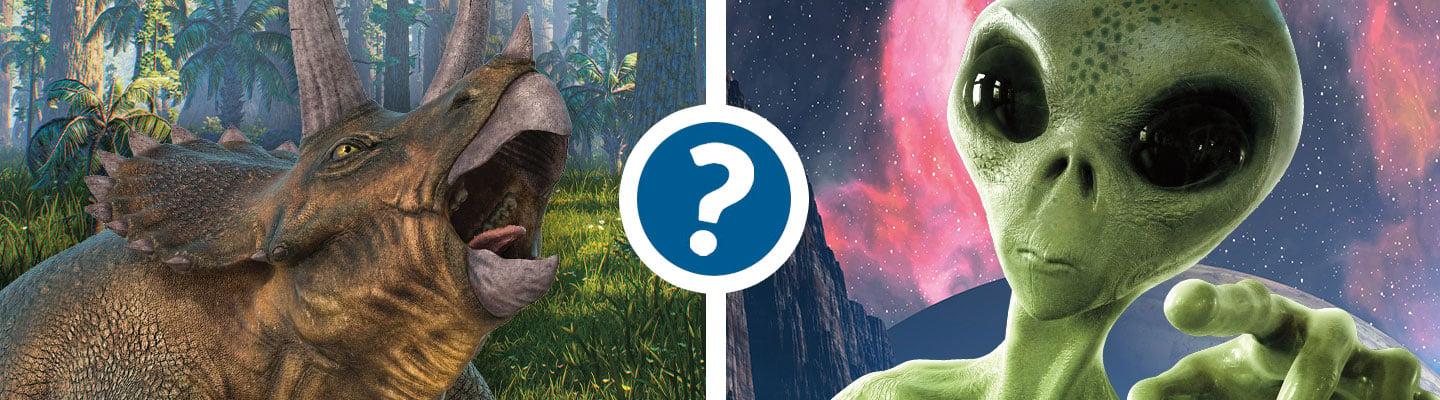
You’re walking through a field of green ferns in an ancient forest. Suddenly, you hear a loud CRUNCH! You turn around and gasp. Lumbering past is a massive Triceratops. It’s bigger than an elephant, with two impressive 0.9 meter (3 foot)-long horns jutting out over its eyes. A third horn comes to a point on its nose. You’re staring at an actual dinosaur! To meet one of these giant prehistoric reptiles, you’d have to travel back in time to between 243 million and 66 million years ago—before the creatures went extinct.

Everything we know about dinosaurs today comes from studying their fossils. Teeth, bones, and other preserved remains provide paleontologists—scientists who study Earth’s ancient life—with clues about what dinosaurs ate, how they looked, and how they behaved. Meeting a dinosaur in real life would be an incredible opportunity, “both to test our predictions and to appreciate another animal who’s shared this planet with us,” says Alexander Clark. He’s a paleontologist at the Field Museum in Illinois.

So far, scientists have identified more than 1,000 dinosaur species. Some had feathers, some had horns, and some were no bigger than a house cat! Some, like Triceratops, were herbivores, or plant eaters. Others, like the famed Tyrannosaurus rex, were meat-eating carnivores. “We know T. rex could run fast, had large eyes that faced forward like a lion, and had half of its big brain dedicated to its sense of smell,” says Clark. “If it wanted to find you, it could.”

You walk through a field of green ferns in an ancient forest. Suddenly, you hear a loud CRUNCH! You turn around and gasp. A massive Triceratops lumbers past. It’s bigger than an elephant. Two impressive horns jut out over its eyes. They’re 0.9 meter (3 feet) long! A third horn comes to a point on its nose. You’re staring at an actual dinosaur! But these giant prehistoric reptiles are long extinct. To meet one, you’d have to travel back in time to between 243 million and 66 million years ago.

Today, we know about dinosaurs only from their fossils. These are teeth, bones, and other preserved remains. Scientists called paleontologists study Earth’s ancient life. Fossils give them clues about what dinosaurs ate, how they looked, and how they behaved. But that’s nothing like meeting a dinosaur in real life. That would be an amazing opportunity, “both to test our predictions and to appreciate another animal who’s shared this planet with us,” says Alexander Clark. He’s a paleontologist at the Field Museum in Illinois.

Scientists have identified more than 1,000 dinosaur species so far. Some had feathers or horns. Some were no bigger than a house cat! Dinosaurs like Triceratops were herbivores, or plant eaters. Others were meat-eating carnivores. The famed Tyrannosaurus rex was one of these. “We know T. rex could run fast, had large eyes that faced forward like a lion, and had half of its big brain dedicated to its sense of smell,” says Clark. “If it wanted to find you, it could.”

ALIEN ENCOUNTER

Your spaceship lands on a strange planet, trillions of miles from Earth. Climbing out of the craft, you gaze at the unfamiliar landscape in front of you. There’s something alive out there—and it’s coming closer. You’re about to come face-to-face with an alien!

For decades, scientists have been searching for life beyond our planet. So far, no one has found any direct evidence of aliens—but that doesn’t mean they don’t exist. After all, space is a big place. “I am certain there is life out there somewhere,” says Theresa Fisher, an astrobiologist at Arizona State University who studies possible life in the universe.

Scientists think other planets and moons in our very own solar system may harbor life, likely in the form of tiny, single-celled microbes. But the best chances of finding aliens could lie on an exoplanet outside our solar system, says Becky McCauley Rench, an astrobiologist at NASA.

There are 100 billion planets in the Milky Way galaxy—the collection of stars where our solar system is found. But less than 1 percent of these planets have the potential to support life. Scientists think that, like Earth, habitable worlds need liquid water, suitable temperatures, and elements like carbon (C), hydrogen (H), nitrogen (N), and oxygen (O)—the building blocks for life on our planet. But that doesn’t mean aliens will resemble life on Earth. Until we finally discover an extraterrestrial creature, we won’t know for sure!

Your spaceship is trillions of miles from Earth. It lands on a strange planet. You climb out of the craft and gaze around at the unfamiliar landscape. Something is alive out there. It’s coming closer. You’re about to come face-to-face with an alien!

Scientists have searched for life beyond our planet for decades. So far, they haven’t found any direct evidence of aliens. But that doesn’t mean they don’t exist. After all, space is a big place. “I am certain there is life out there somewhere,” says Theresa Fisher, an astrobiologist at Arizona State University. She studies possible life in the universe.

Scientists think other planets and moons in our solar system may harbor life. It’s probably in the form of tiny, single-celled microbes. But the best chances for finding aliens could lie on an exoplanet, says Becky McCauley Rench, an astrobiologist at NASA. Exoplanets are outside our solar system.

There are 100 billion planets in the Milky Way galaxy. This collection of stars includes our solar system. But less than 1 percent of these planets could support life. For planets to be livable, scientists think they’d need some conditions like Earth’s. That includes liquid water, the right temperatures, and elements like carbon (C), hydrogen (H), nitrogen (N), and oxygen (O). These are the building blocks for life on our planet. But aliens might not resemble life on Earth. We won’t know for sure until we finally discover an alien creature!

What does your class think?

What type of creature would you rather meet?

Please enter a valid number of votes for one class to proceed.

What type of creature would you rather meet?

Please select an answer to vote.

What type of creature would you rather meet?

0%
0votes
{{result.answer}}
Total Votes: 0
Thank you for voting!
Sorry, an error occurred and your vote could not be processed. Please try again later.
videos (1)
Skills Sheets (4)
Skills Sheets (4)
Skills Sheets (4)
Skills Sheets (4)
Lesson Plan (2)
Lesson Plan (2)
Text-to-Speech