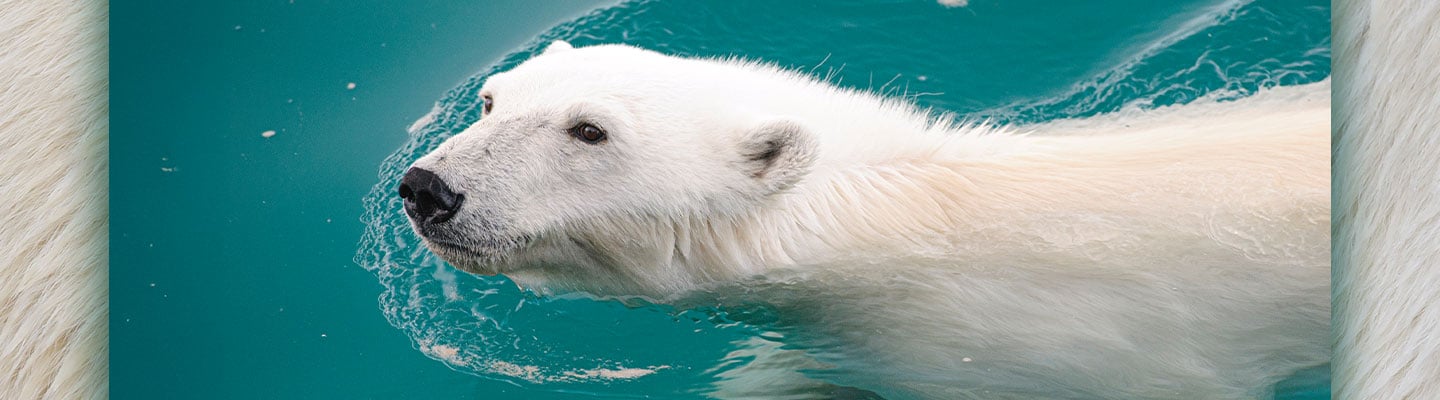
Intrigued, Holst decided to conduct experiments to learn more about the properties of polar bear fur. The Polar Institute provided samples of fur for analysis. Holst and co-investigator Julian Carolan, a materials scientist at Trinity College in Ireland, examined the fur under a microscope. They looked at human hair as well. “We thought about photos of polar explorers whose beards were full of ice,” says Holst. “We suspected human hair would be an interesting comparison and probably not as good at anti-icing.”
The structure of polar bear fur looked similar to human hair, just with wider strands. But “it was obvious that the fur was covered in grease, and the samples smelled quite strongly,” says Holst. The oily substance was sebum, which protects and lubricates the skin of many mammals, including humans. The scientists wondered if it was the key to the fur’s slipperiness.
Next, Holst and Carolan tested the adhesion, or attachment strength, of ice to the fur—and to greasy human hair. “I let my hair get greasy by going just over a week without washing and then shaving it off,” says Carolan. “The process was a little gross,” he adds, so it was a relief to finally shave. The researchers froze blocks of ice onto the samples of Carolan’s greasy hair and polar bear fur. They then used a device to measure the amount of force needed to push the ice blocks off the samples.
The researchers repeated the experiment with washed samples of fur and human hair to see if removing sebum affected adhesion. They also did the same test with ski skins. Backcountry skiers attach these pads to skis when climbing hills. The pads provide grip to prevent skiers from slipping back down a hill—but they must glide smoothly when skiers are moving forward uphill. The skins are made of goat hair sprayed with synthetic, or lab-made, coatings to enhance glide. These nonstick coatings often contain PFAS, chemicals that are harmful to both human health and the environment (see “You Can’t Escape These Chemicals!,” Science World, March 13, 2023).
The results of the experiments showed that unwashed polar bear fur releases ice far more easily than greasy human hair, washed human hair, and washed fur. It’s also about as slippery as the top-performing ski skin coated with PFAS (see “Freeze Test”). Carolan was excited about the results—even if he was “maybe a little disappointed” to learn that his own hair had no anti-icing properties.