

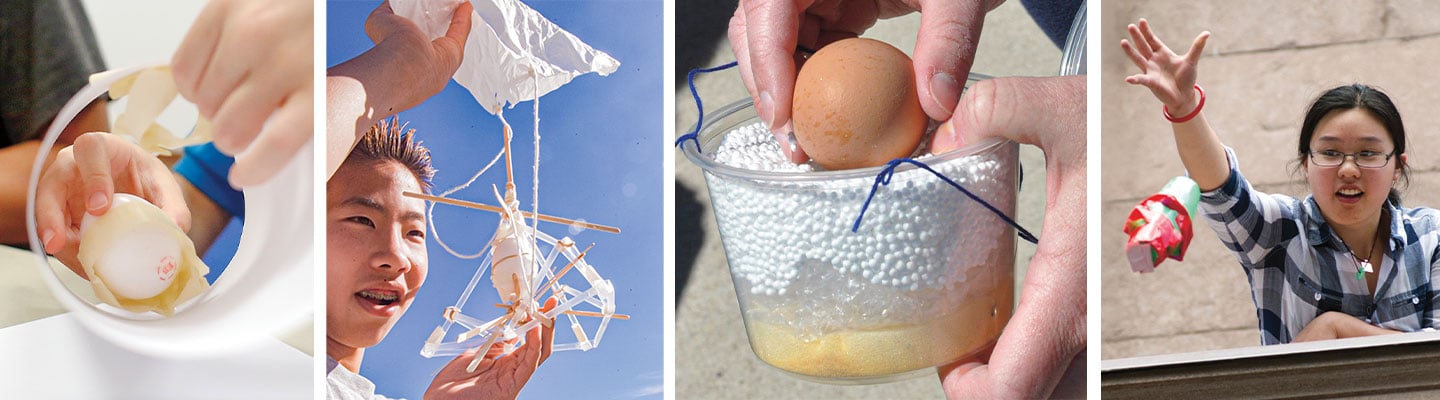

Hands placing a peeled hard-boiled egg into a bowl, hands holding a parachute model, hands lowering an egg into a container with foam beads, girl with glasses holding a decorated egg and waving

LEFT TO RIGHT: © OCTAVIO JONES/TAMPA BAY TIMES VIA ZUMA PRESS WIRE, CALIFORNIA STATE UNIVERSITY NORTHRIDGE, 2014; HAZLETON STANDARD-SPEAKER ELLEN F. O’CONNELL/AP IMAGES, MACADOO-KELAYRES ELEMENTARY SCHOOL, PA, 2012; FRANCES ROBERTS/ALAMY STOCK PHOTO, COOPER UNION ENGINEERING NYC, 2012; BORIS YARO/LOS ANGELES TIMES VIA GETTY IMAGES, WEST HERNANDO BRANCH LIBRARY, FL 2014. 

STANDARDS

NGSS: Core Idea: PS2.A, PS3.A, ETS1.B

CCSS: RI.9

TEKS: 6.3A, 7.3A, 8.3A, PHYS.7B

Standards

Egg-cellent Engineering

Tips from a new study and world record could help you succeed at a classic engineering challenge: the egg drop.

AS YOU READ, THINK ABOUT how best to prevent an egg from cracking when dropped.

In August 2024, Derrick Wood climbed onto a platform attached to a lift outside the American Helicopter Museum in Pennsylvania. The Conestoga High School chemistry teacher, who’s not a fan of heights, waited anxiously as the vehicle carried him eight stories into the air. Wood carried an egg nestled inside a contraption his students had made using simple materials—including paper, string, and straws. Could the device keep the egg intact after plummeting more than 24 meters (80 feet)?

Wood was attempting a record-breaking egg drop. Egg drops are a popular activity for middle and high school students across the country. The goal is to build a simple device capable of protecting an egg when dropped. A few years earlier, Wood and a few of his students had set a Guinness World Record for the highest successful egg drop, at 13.3 m (43.7 ft). Then, in 2023, a college student in India broke that record with a drop from 16.8 meters (54.1 feet).

A year later, Wood and his students—who call themselves the T/E Egg Drop Team—hoped to reclaim their title. They didn’t realize it at the time, but the device they’d developed for the challenge took advantage of a strategy supported by recent research. It turns out that an egg’s orientation when striking a surface affects its chances of cracking. Would their design be enough to take back the egg drop record?

In August 2024, Derrick Wood climbed onto a platform. It was attached to a lift outside the American Helicopter Museum in Pennsylvania. The Conestoga High School chemistry teacher doesn’t like heights. As the vehicle lifted him eight stories, he waited nervously. Wood carried an egg tucked inside a contraption. His students had made it from simple materials like paper, string, and straws. The egg was about to fall more than 24 meters (80 feet). Could the device keep it from breaking?

Wood was attempting a record-breaking egg drop. Egg drops are a popular activity for middle and high school students across the country. The goal is to build a simple device that can protect an egg when dropped. A few years earlier, Wood and some of his students had set a Guinness World Record. They’d performed the highest successful egg drop, at 13.3 m (43.7 ft). Then a college student in India broke their record in 2023. That drop was from 16.8 m (54.1 ft).

A year later, Wood and his students hoped to regain their title. They call themselves the T/E Egg Drop Team. The team came up with an idea and developed a device for the challenge. They didn’t know it then, but recent research supported their idea. When an egg strikes a surface, its orientation affects its chances of cracking. Would their design take back the egg drop record?

BREAKING SOME EGGS

BORIS YARO/LOS ANGELES TIMES VIA GETTY IMAGES, 2014

SMASHED: A student examines the aftermath of his team’s entry in an egg drop in Los Angeles, California.

Annual egg drops are also a tradition at many colleges, including the Massachusetts Institute of Technology (MIT). Professors often shared a piece of advice with engineering students: Eggs would be more likely to survive if they were oriented vertically rather than horizontally. “We followed that conventional wisdom,” says MIT engineering professor Tal Cohen.

At MIT and elsewhere, experts reasoned that the more pronounced curves at the top and bottom of an egg would better protect against the force of hitting the ground than its gently sloped sides. This thinking was based in part on the use of arches in architecture. Arches help support the loads acting on a structure—like its weight and other forces.

But Cohen and her colleagues wondered what people who hadn’t heard this traditional advice would think. So they spoke with non-scientists around MIT’s campus, such as custodial staff and landscapers. Many of these community members suspected eggs dropped on their side would be safer. That’s when Cohen decided, “Let’s check!”

Yearly egg drops are also a tradition at many colleges. The Massachusetts Institute of Technology (MIT) is one of them. Professors often gave engineering students a piece of advice: They should position the eggs vertically, not horizontally. Then the eggs would be more likely to survive. “We followed that conventional wisdom,” says MIT engineering professor Tal Cohen.

An egg’s sides are gently sloped. But the curves at its top and bottom are sharper. It seemed that these curves would better protect against the force of hitting the ground. Experts reasoned this way partly because of arches in architecture. Arches help support the loads on a structure. These include its weight and other forces.

But many people had never heard this traditional advice. What would they think? Cohen and her team asked non-scientists around MIT’s campus. These community members included custodial staff and landscapers. Many of them thought eggs dropped on their side would be safer. So Cohen decided, “Let’s check!”

Cohen’s team squeezed eggs in clamps and measured how much force they could withstand before cracking. Whether positioned horizontally or vertically, the maximum force was about the same. The shell’s strength is roughly equal either way. But the researchers detected one interesting difference: Eggs squeezed on their sides flexed a little more before breaking than those compressed from top to bottom (see Crush Test).

Next the researchers dropped eggs. Those that landed on their sides were less likely to break than those that landed on their ends. Eggs that land sideways “can absorb more energy and fall from higher before breaking,” explains Joseph Bonavia, a mechanical engineer who worked on the study.

Before an egg is dropped, it has potential energy. As it falls, that stored energy from its height changes into kinetic energy—or energy of motion. Flexing on impact absorbs some of that kinetic energy, which helps prevent cracking. Think of how a ball made of glass—a rigid material—shatters when dropped. But a rubber ball can squish and bounce back. The MIT findings suggest that the conventional wisdom is wrong. Eggs dropped vertically didn’t survive better—they broke more often.

Cohen’s team squeezed eggs in clamps. They measured the amount of force needed to crack them. Some eggs were positioned horizontally and some vertically. But the maximum force was about the same. The shell’s strength is roughly equal either way. The researchers found one interesting difference. Eggs squeezed on their sides flexed a little more before breaking. Those squeezed from top to bottom flexed less (see Crush Test).

Next the researchers dropped eggs. Some landed on their sides. They were less likely to break than those that landed on their ends. Eggs that land sideways “can absorb more energy and fall from higher before breaking,” explains Joseph Bonavia. He’s a mechanical engineer who worked on the study.

Before an egg drops, it has potential energy. This is stored energy from its height. As the egg falls, potential energy changes into kinetic energy, or energy of motion. Flexing on impact absorbs some of that kinetic energy and helps prevent cracking. Think about a ball made of glass. When dropped, this rigid material shatters. But a rubber ball can squish and bounce back. The MIT findings suggest that the conventional wisdom is wrong. Eggs dropped vertically didn’t survive better. They broke more often.

REACHING NEW HEIGHTS

The T/E Egg Drop Team didn’t know about MIT’s results when attempting to regain their record title. (The study hadn’t been released yet.) But the group had a hunch that an egg oriented horizontally would fare better.

The team’s students included Matthew Ma, Charlie Gawthrop, and Jeffrey Wang, who’d worked together to set the initial record in ninth grade in 2022. For the 2024 attempt, they were joined by then-sixth-grader Breckin Shefflerwood. The group didn’t want to just beat the current record—they wanted to blow way past it. “We said, ‘We’re going big this time,’” says Wood.

For their device, the team could use only materials permitted in a Guinness World Record egg drop—including pieces of plastic bag, elastic cord, note cards, cardboard, foam, straws, and tape. They tested their contraption by using a drone to drop an egg from 30.5 m (100 ft). That successful test gave them confidence in their design but didn’t count for the record, which requires releasing the egg by hand.

On the big day, supporters gathered to watch. Breckin, the youngest team member, prepared to film the drop in a slow-motion video, which Guinness required. “I was thinking, ‘I don’t want to be the person to mess this up!’” he recalls. “We all worked so hard.”

Wood dropped the egg, laid on its side in the team’s contraption, from a height of 25.3 m (83 ft). Breckin captured its graceful descent, slowed by a plastic-bag parachute. After its landing, Matthew checked that it was intact. Once its survival was documented on video, Matthew grinned and threw the egg to the ground. It splattered—providing the required proof that the egg wasn’t hard-boiled. A few weeks later, confirmation came: The record was theirs again!

Now the T/E Egg Drop Team was trying to regain their record title. They didn’t know about MIT’s results. (The study hadn’t been released yet.) But the group guessed that a horizontal egg would fare better.

The team’s students included Matthew Ma, Charlie Gawthrop, and Jeffrey Wang. They had set the first record together in ninth grade in 2022. For the 2024 attempt, Breckin Shefflerwood joined them. He was in sixth grade. The group didn’t want to just beat the current record. They wanted to blow way past it. “We said, ‘We’re going big this time,’” says Wood.

Only certain materials are allowed in a Guinness World Record egg drop. They include pieces of plastic bag, elastic cord, note cards, cardboard, foam, straws, and tape. The team tested their contraption with a drone. It dropped an egg from 30.5 m (100 ft). The egg didn’t break. That test gave them confidence in their design. But it didn’t count for the record. For that, the egg must be released by hand.

The big day came, and supporters gathered to watch. Guinness required a slow-motion video of the drop. Breckin, the youngest team member, got ready to film it. “I was thinking, ‘I don’t want to be the person to mess this up!’” he recalls. “We all worked so hard.”

The egg laid on its side in the team’s contraption. Wood dropped it from 25.3 m (83 ft). Breckin filmed its graceful fall, slowed by a plastic-bag parachute. It landed, and Matthew checked the egg. It was intact. The team captured its survival on video. Then Matthew grinned and threw the egg to the ground. It splattered. This proved that the egg wasn’t hard-boiled. It was another requirement for the Guiness record. A few weeks later, the news came. The record was theirs again! 

DESIGNING SOLUTIONS: Design your own protective device for an egg. Use evidence from the text to explain why you think your design would work.

What does your class think?

Have you ever participated in an egg drop challenge?

Please enter a valid number of votes for one class to proceed.

Have you ever participated in an egg drop challenge?

Please select an answer to vote.

Have you ever participated in an egg drop challenge?

0%
0votes
{{result.answer}}
Total Votes: 0
Thank you for voting!
Sorry, an error occurred and your vote could not be processed. Please try again later.
videos (1)
Skills Sheets (4)
Skills Sheets (4)
Skills Sheets (4)
Skills Sheets (4)
Lesson Plan (2)
Lesson Plan (2)
Text-to-Speech