
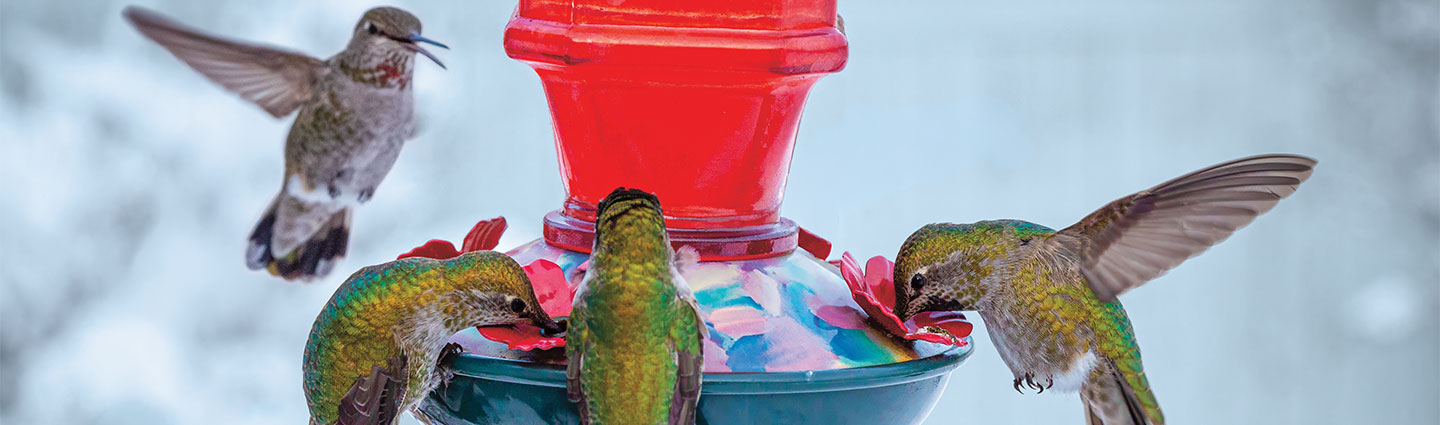

Four hummingbirds feeding at a red feeder with artificial flowers

ALL YOU CAN EAT: A group of Anna’s hummingbirds drinking from a feeder during the winter in California

TRACIE HOWE PHOTOGRAPHY/ ALAMY STOCK PHOTO

STANDARDS

NGSS: Core Idea: LS4.B, LS4.C

CCSS: RI.2

Standards

Investigate It!

Is Your Feeder Reshaping Hummingbirds?

Scientists discover that access to plentiful food has transformed hummingbirds’ beaks.

AS YOU READ, THINK ABOUT how living near humans might influence animal evolution.

ZIP! Something darts past your window. The blur of brown and green dips and dives around the backyard. It’s a tiny hummingbird—and it’s searching for food. It zooms over to a bright-red hummingbird feeder and quickly slurps up some of the sugary liquid inside. Soon a rival hummingbird, also looking for a meal, zooms in and chases it away.

Hummingbirds are fast and skilled fliers. They’re the only birds that can hover, go backward, and even fly upside down. These midair maneuvers help them flit between flowers to sip sweet nectar. The birds depend on this sugar-rich liquid for energy. But flowers are no longer hummingbirds’ only food source, thanks to backyard feeders. These containers are filled with sugar water that mimics nectar. Hummingbirds can insert their long beaks into holes in the feeder and gulp down delicious food.

The growing popularity of these feeders made biologist Nicolas Alexandre curious. At the time, Alexandre was a Ph.D. student at the University of California, Berkeley. He wondered if hummingbirds’ artificial source of food could be affecting one trait in particular: their beaks.

ZIP! Something darts past your window. You see a blur of brown and green. It dips and dives around the backyard. It’s a tiny hummingbird! And it’s searching for food. The bird zooms over to a bright-red hummingbird feeder. It quickly slurps up some of the sugary liquid inside. Soon another hungry hummingbird zooms in. It chases the first bird away.

Hummingbirds are fast and skilled fliers. They’re the only birds that can hover, go backward, and even fly upside down. These fancy moves help them sip sweet nectar from flowers. This sugar-rich liquid gives the birds energy. But flowers aren’t the only food source for hummingbirds. Today they can also drink from backyard feeders. These containers are filled with sugar water. It’s similar to nectar. Hummingbirds poke their long beaks into holes in the feeder. Then they gulp down the tasty food.

Feeders are getting more popular. That made biologist Nicolas Alexandre curious. Alexandre was a Ph.D. student at the University of California, Berkeley. He wondered if feeders could cause changes to hummingbird beaks.

DAN SULLIVAN/ALAMY STOCK PHOTO

NATURAL DIET: An Anna’s hummingbird feeding on a flower in California

MEASURING UP

Alexandre and a team of researchers decided to investigate. They focused on Anna’s hummingbird (Calypte anna), a species that lives along the west coast of North America (see “Expanding Range”). The group set out to see if C. anna’s beaks had changed over time as hummingbird feeders became more widespread in California.

The team started by searching newspaper sales sections, going back decades looking for mentions of hummingbird feeders. They found that feeders first appeared in Southern California in the early 1940s, then their popularity spread northward.

Next the team headed to Berkeley’s Museum of Vertebrate Zoology, which has hundreds of preserved Anna’s hummingbirds. They’re stored in drawers in the museum’s archive—a vast collection of specimens that the public rarely, if ever, gets to see. The researchers examined birds dating from current times all the way back to the 1860s—long before hummingbird feeders were found on the West Coast. The scientists propped up each hummingbird specimen on a special stand to measure and photograph its beak, also known as a bill. “Starting in the 1940s, we were able to see a distinct difference in bill size,” says Alexandre. In areas where feeders have become common, hummingbirds’ bills are longer—about 1 millimeter (0.04 inches) on average. C. anna grows to only about 10 centimeters (4 in.) long, so that’s a big difference for such a tiny bird!

Alexandre and a team of researchers decided to investigate. They focused on Anna’s hummingbird (Calypte anna). This species lives along the west coast of North America (see “Expanding Range”). The group set out to see if C. anna’s beaks had changed. They checked if this happened as hummingbird feeders became more common in California.

The team started by searching newspaper sales sections going back decades. They looked for mentions of hummingbird feeders. They found that feeders first appeared in Southern California in the early 1940s. Then they spread north from there.

Next the team headed to Berkeley’s Museum of Vertebrate Zoology. The museum has hundreds of preserved Anna’s hummingbirds. They’re stored in drawers in the museum’s archive. It’s a big collection that doesn’t usually go on display. The researchers examined birds dating from current times all the way back to the 1860s. That’s long before anyone had hummingbird feeders on the West Coast. The scientists set each preserved bird on a special stand. They measured and photographed its beak, also known as a bill. “Starting in the 1940s, we were able to see a distinct difference in bill size,” says Alexandre. In areas where feeders are common, hummingbirds’ bills are longer—about 1 millimeter (0.04 inches) on average. C. anna grows to only about 10 centimeters (4 in.) long. That’s a big difference for a tiny bird!

FOOD BOOM

Hummingbirds already have incredibly long bills for their body size. C. anna’s bill is typically about 2.5 cm (nearly 1 in.) long—or one-fifth its body length. These long bills are likely an adaptation—a trait that allows the animals to better survive in their environment. The bills help the birds reach nectar found deep inside trumpet-shaped flowers. But when birds are feeding mainly on nectar, having the longest bill doesn’t necessarily give them the best chance at survival, explains Alexandre. The longer the bill, the more mistakes a hummingbird can make when entering the flower.

That’s not an issue when it comes to feeders. Hummingbirds don’t need to be accurate when they stick their bills into the holes of a feeder’s tank because there’s a huge reservoir of sugary liquid inside. And a longer bill allows them to drink up the plentiful liquid even faster—making it a more desirable trait.

The change to the birds’ beaks was greatest in areas with the largest number of hummingbird feeders. This suggests that the species evolved, or changed over generations, to favor individuals with bills that were better suited for feeding on this new food source. “This finding was really exciting to us!” says Alexandre.

The team also noticed another change in hummingbirds’ bills: In males, they became pointier. Despite their small size, male hummingbirds are aggressively territorial, or protective of their space. In the wild, they’ll often claim and defend a plant that has a lot of nectar. They fend off competition by using their bills like swords. “They can be very stabby,” says Alexandre.

To a hummingbird, a feeder is like an all-you-can-eat buffet. Because of this, multiple hummingbirds will often try to take over the same feeder. “Hummingbirds interacting around a feeder look like a blur,” says Alejandro Rico-Guevara, who led the study. He’s an evolutionary biologist at the University of Washington’s Burke Museum. “But when you record them with high-speed cameras and slow down the video, you see that they are chasing and attacking each other.” For these birds, a pointier bill makes a better weapon.

Hummingbirds already have incredibly long bills for their body size. C. anna’s bill is typically about 2.5 cm (nearly 1 in.) long. That’s about one-fifth its body length. These long bills are likely an adaptation. That’s a trait that allows animals to better survive in their environment. Long bills help the birds reach nectar found deep inside flowers. When birds are feeding mainly on nectar, the longest bill isn’t always the best, says Alexandre. A long bill has to be aimed just right to reach nectar inside a flower.

Eating at a feeder is different. Hummingbirds don’t need to be accurate when they stick their bills into a feeder’s tank. There’s a huge amount of sugary liquid inside. A longer bill allows them to drink it even faster. So a longer bill is better for survival when feeders are around

The change to the birds’ beaks was greatest in areas with the most feeders. This suggests that the species evolved, or changed over generations, in a specific way. Some individuals had bills that were better suited for feeding on the new food source. Those birds were more successful, and the longer bills became more common.  “This finding was really exciting to us!” says Alexandre.

The team noticed another change in hummingbirds’ bills. The bills of males became pointier. Male hummingbirds are very territorial. They protect their space. In the wild, they’ll often claim and defend a plant with a lot of nectar. They fight off other hummingbirds by using their bills like swords. “They can be very stabby,” says Alexandre.

A feeder is like an all-you-can-eat buffet for hummingbirds. So multiple hummingbirds will often try to take over the same feeder. “Hummingbirds interacting around a feeder look like a blur,” says Alejandro Rico-Guevara, who led the study. He’s an evolutionary biologist at the University of Washington’s Burke Museum. “But when you record them with high-speed cameras and slow down the video, you see that they are chasing and attacking each other.” For these birds, a pointier bill makes a better weapon.

ISTOCKPHOTO/GETTY IMAGES

DUELING BEAKS: Two male Anna’s hummingbirds clash over food.

EVOLUTION IN ACTION

Many people think of evolution as something that happens over millions of years. Through the process of natural selection, animals that are better adapted to their environment survive to pass on their traits to more offspring. But Alexandre’s study shows that evolution can happen much faster. The bills of Anna’s hummingbirds transformed over the course of 80 years. “I did not expect to see changes in such a short amount of time,” says Rico-Guevara.

Rapid evolution hasn’t only been documented in hummingbirds. It often occurs in places where species interact closely with humans. Pigeons, for example, originally made their nests on cliffs. When humans constructed skyscrapers, the birds started nesting on the tall buildings instead. A similar thing happened to bighorn sheep, which hunters prize for their long, curved horns. In recent decades, some of these animals have begun evolving shorter horns—a trait that makes them a less-desirable target.

Scientists are just beginning to learn how and why this type of rapid evolution occurs—and they still have plenty of questions about the phenomenon. “Many of the answers are in those drawers in museums,” says Rico-Guevara. “You just have to open them and ask the right questions.”

Many people think of evolution as changes happening over millions of years. Certain animals are more successful at surviving in their environment than others. They pass on their traits to more offspring. That process is called natural selection. But Alexandre’s study shows that evolution can also happen quickly. The bills of Anna’s hummingbirds changed in just 80 years. “I did not expect to see changes in such a short amount of time,” says Rico-Guevara.

Fast evolution happens in other animals too. It often happens in areas where humans affect other species. Pigeons, for example, originally made nests on cliffs. Then humans built skyscrapers. The birds started nesting on these tall buildings instead. Another example is bighorn sheep. Hunters wanted their long, curved horns. Recently, some of these animals have begun evolving shorter horns. That trait makes them less of a target for hunting.

Scientists are just beginning to learn how and why this type of rapid evolution occurs. They still have plenty of questions about it. “Many of the answers are in those drawers in museums,” says Rico-Guevara. “You just have to open them and ask the right questions.”

videos (1)
Skills Sheets (4)
Skills Sheets (4)
Skills Sheets (4)
Skills Sheets (4)
Lesson Plan (2)
Lesson Plan (2)
Text-to-Speech