

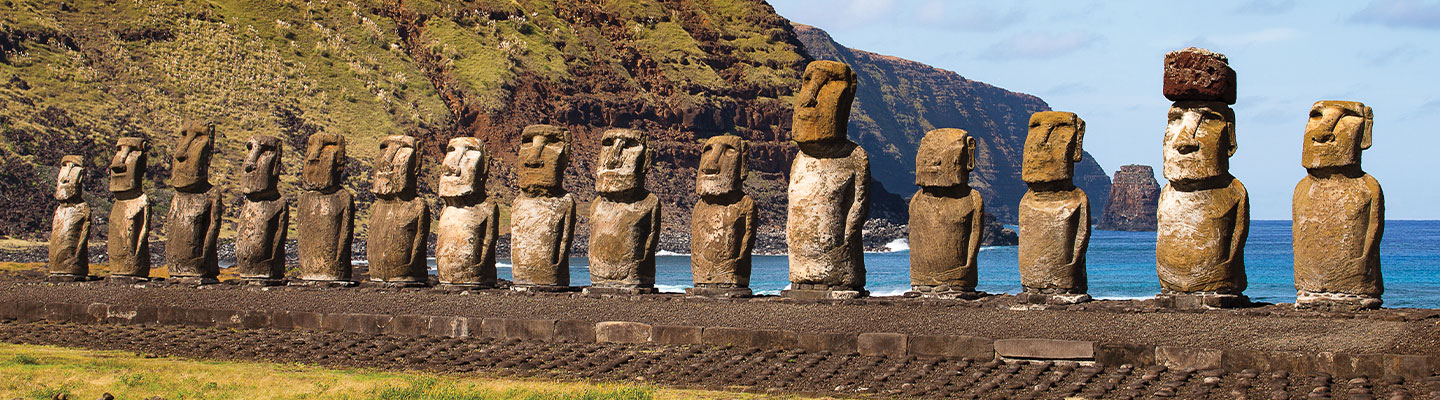

Row of moai statues on Easter Island with green hillside and ocean in background

SURGING SEAS: Most moai sit on the edge of Rapa Nui on giant stone platforms called ahu (AH-hoo). As rising sea levels caused by climate change increase flooding and coastal erosion, the platforms are at risk of washing into the sea.

CHAKARIN WATTANAMONGKOL/GETTY IMAGES

STANDARDS

NGSS: Core Idea: ESS2.A, ESS2.C

CCSS: RI.2

TEKS: 6.3B, 7.3B, 8.3B, EARTH.9B

Standards

Vanishing Statues

The famed stone heads of Easter Island have stood for centuries—but they’re in danger of weathering away.

AS YOU READ, THINK ABOUT the challenges that scientists face when attempting to preserve ancient stone artifacts.

CHAKARIN WATTANAMONGKOL/GETTY IMAGES

IMPORTANT ATTRACTION: Rapa Nui’s economy is tourism-based. According to anthropologist Terry Hunt, the people of Rapa Nui “realize that if all the moai were weathered away, no one would come to the island for tourism. And there’d be no economy.”

On Easter Island, a remote speck of land in the middle of the Pacific Ocean, hundreds of stone giants stand guard. These are the moai (MOH-eye). Indigenous Polynesian people, who called the island Rapa Nui, created the moai between 1250 and 1600 A.D. Today the figures are an important part of the island’s history. Unfortunately, the moai are in trouble. Within the next century, they may become nothing more than faceless lumps.  

Easter Island is a remote speck of land in the middle of the Pacific Ocean. Hundreds of stone giants stand guard there. These are the moai (MOH-eye). Indigenous Polynesian people called the island Rapa Nui. They created the moai between 1250 and 1600 A.D. Today the figures are an important part of the island’s history. Sadly, the moai are in trouble. They may turn into faceless lumps within the next century.  

CHAKARIN WATTANAMONGKOL/GETTY IMAGES

LOTS OF LICHENS: About 70 percent of the moai statues are plagued by lichens. These fuzzy colonies of algae and fungus soften the stone to a claylike consistency, deforming its features.

The Rapa Nui people cut the moai from blocks of tuff. This stone, formed from compressed volcanic ash, is relatively soft. That makes it easy to carve. But tuff’s softness also makes it vulnerable to things like rain and wind, which gradually weather, or wear away, the stone. Tuff is also porous. Salt from ocean spray crystallizes in its many tiny holes, further breaking down the rock. 

Worsening weather caused by climate change is causing the statues to deteriorate even faster. “In the last few years, I’ve seen more thunderstorms on Rapa Nui than ever before,” says Terry Hunt. He’s an anthropologist from the University of Arizona who studies the history of the Rapa Nui people.

The Rapa Nui people cut the moai from blocks of tuff. This stone formed from compressed volcanic ash. It’s relatively soft, so it’s easy to carve. But the soft stone is more easily affected by things like rain and wind. They weather the stone, or wear it away over time. Tuff is also porous, with many tiny holes. Salt from ocean spray crystallizes inside them. This also breaks down the rock. 

Because of climate change, weather is getting worse. That’s damaging the statues even faster. “In the last few years, I’ve seen more thunderstorms on Rapa Nui than ever before,” says Terry Hunt. He’s an anthropologist from the University of Arizona. Hunt studies the history of the Rapa Nui people.

WERNER FORMAN/ UNIVERSAL IMAGES GROUP/GETTY IMAGES

TREASURES OF THE PAST: Rapa Nui is home to more than 30,000 archaeological sites, including tombs, abandoned villages, and petroglyphs, or rock carvings.

Researchers have applied chemicals to some of the moai to seal off the stone and repel moisture. But these treatments are expensive, and they risk further damaging the fragile figures. Scientists have also used drones to make 3-D scans of the moai. This digitally preserves the statues while also helping track changes to the figures over time. Researchers and islanders hope to find more ways to keep these statues standing—preserving the island’s past well into the future.

Researchers have applied chemicals to some of the moai. The chemicals seal off the stone and repel moisture. But these treatments are expensive, and they could damage the fragile figures further. Scientists have also used drones to make 3-D scans of the moai. This digitally preserves the statues, and it helps track changes to the figures over time. Researchers and islanders are looking for more ways to keep these statues standing. They hope to preserve the island’s past well into the future.

CONSTRUCTING EXPLANATIONS: Describe why statues carved from tuff are more vulnerable to wearing away, especially as climate change causes more extreme weather.

videos (1)
Skills Sheets (4)
Skills Sheets (4)
Skills Sheets (4)
Skills Sheets (4)
Lesson Plan (2)
Lesson Plan (2)
Text-to-Speech