
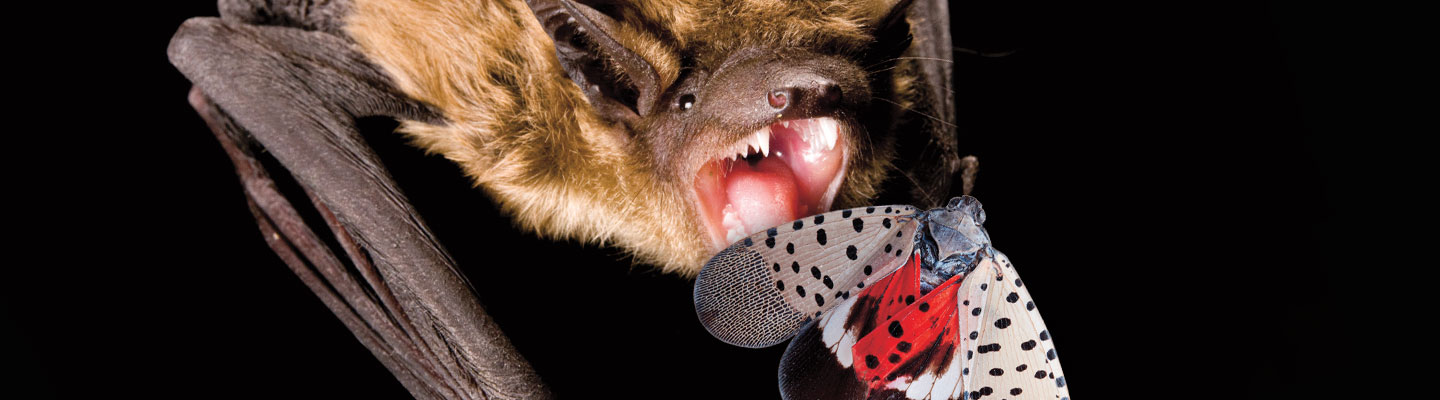

INSECT HUNTER: The big brown bat is a species found throughout North America.

JOEL SARTORE/PHOTO ARK/NATUREPL.COM (BAT); SHUTTERSTOCK.COM (LANTERNFLY)

Standards

Lanternfly Detective

Erin McHale studies how bats can help stop a pesky invader: the spotted lanternfly.

ERIN MCHALE

HANDLE WITH CARE: McHale gently removes a brown bat from a net. (Remember: Only wildlife experts should handle bats.)

SHUTTERSTOCK.COM

Erin McHale is often out in the woods at night. She’s trying to catch bats. McHale is a Ph.D. student at Rutgers University in New Jersey studying ecology—how organisms interact with each other and their environment. Bats are her main research subject. While out looking for the animals, McHale noticed something else flying around in the dark: spotted lanternflies. This surprised McHale. She thought lanternflies only came out during the day, making them safe from nighttime hunters like bats.

Spotted lanternflies are native to parts of Asia. But in the United States, they’re an invasive species. The insects first appeared in the U.S. in Pennsylvania in 2014. Without any natural predators, lanternflies quickly spread and are now found in 15 states. They feed on plants, harming certain trees and crops.

McHale knew that New Jersey’s bats ate all sorts of pests. What if bats were eating spotted lanternflies too? To find out, McHale began looking for traces of lanternflies in bat poop—and she found some! Bats are indeed helping to get rid of the bugs. Recently, McHale spoke with Science World about her research on bats and invasive insects.

How did you become interested in ecology?

When I was little, I used to go to farms with my mom to see the animals. I also spent a lot of time outdoors. Later, when I was in high school, I did a few internships at zoos in southern New Jersey. I loved being around the animals. My experiences made me think, “Wow, this is really what I want to do!” So I studied biology in college. After graduating, I enrolled in a Ph.D. program at Rutgers University, where I was offered the opportunity to join a research lab studying bats and wildlife conservation. Right now, I’m learning everything I can about what bats eat.

How do you figure out what bats are eating?

KATY DOCKRILL

By examining their poop! There are two ways to collect bat poop. You can look for a bat colony—a group of bats living together—and gather droppings from the ground beneath them. Or you can go into the woods and set up a net. When night falls, the bats come out to eat bugs and fly into our net. We safely take each bat out, examine it, weigh it, and measure its wings. Bats usually poop every 30 minutes. We put their poop into a tube, then send the bat on its way. Back in the lab, I identify DNA—the molecule that carries hereditary information—in the sample to determine which insect species it belongs to. Then I know all the bugs the bat ate.

ERIN MCHALE

BAT DROPPINGS: Collected samples of bat poop

What are you discovering about bats and lanternflies?

KATY DOCKRILL

My research shows that bats are eating many insects that can harm plants and crops, like stinkbugs and corn earworms. When I started this work, the spotted lanternfly was just becoming a problem in New Jersey. This study was the first to detect that bats are preying on this invasive bug. Although the lanternfly is still spreading across the U.S., we suspect that the invasion could have been much worse without the help of bats.

Do you have advice for students interested in ecology?

Look at scientists already helping with conservation and see how you can follow in their footsteps. If there’s a wildlife organization doing something you admire, call them and say, “Hey, I’m really interested in your work; can I help a few days a week?” Find volunteer opportunities and internships. You may have to do unpaid work, which is hard. All of it will add to your experience. If you have a passion, don’t give up on it. It’s important to keep going.

LANCE CHEUNG/USDA/SCIENCE SOURCE

INSECT INVADER: Lanternflies are damaging important trees and crops as they spread across the U.S.

videos (1)
Skills Sheets (2)
Skills Sheets (2)
Lesson Plan (1)
Text-to-Speech