
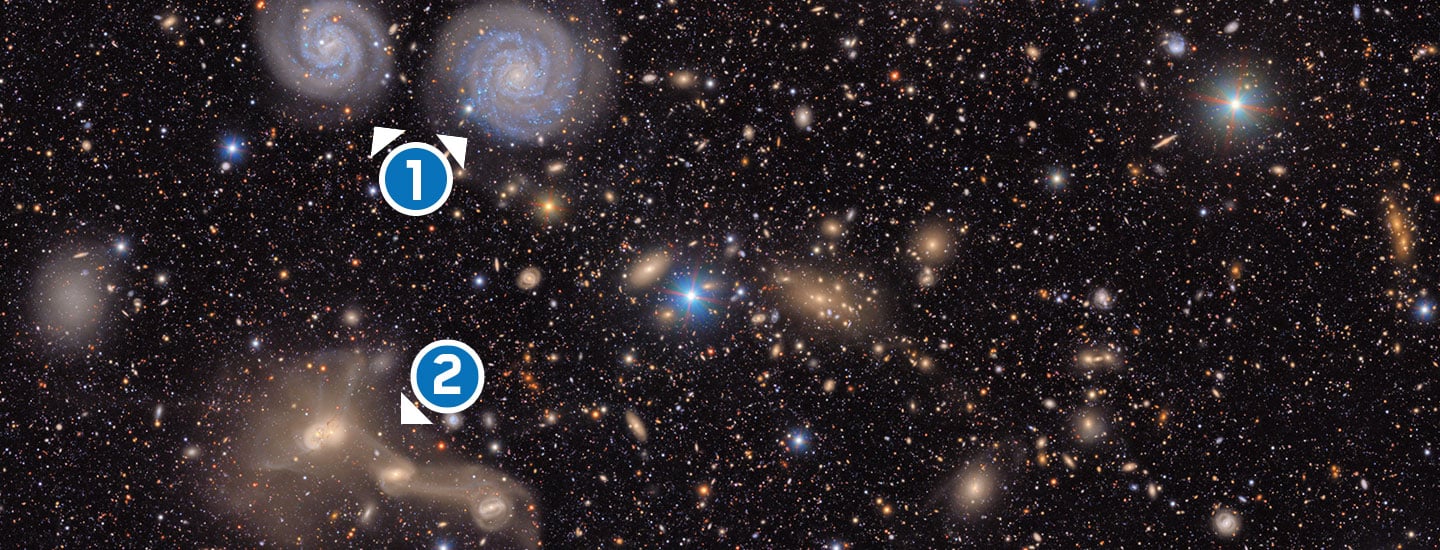

Last June, thousands of people gathered at planetariums, museums, libraries, and universities across six continents for an out-of-this-world watch party. The groups joined a livestream hosted by the U.S. National Science Foundation. During the stream, astronomers unveiled the first-ever images from the recently completed Vera C. Rubin Observatory. The pictures showed stunning views of outer space, including colorful clouds of gases, pulsating stars, and millions of glowing galaxies, or huge collections of stars.
The celestial objects photographed by the Rubin Observatory are located thousands of light-years from Earth. One light-year equals about 9.5 trillion kilometers (5.9 trillion miles). But in the pictures, these objects look close enough to touch. The new observatory’s telescope can capture such sharp images of far-off objects because it contains the largest digital camera ever built. The camera is about the size of a car!
These incredible pictures taken by the Rubin Observatory are just the beginning. Over the next 10 years, researchers will use its highly sensitive camera to take about 2 million photos. “It will really help us to get a better idea of what else is out there,” says Michaela Musilova, an astrobiologist who studies the possibility of life in space. The images will allow scientists around the world to observe our universe in a whole new light.
Last June, thousands of people attended an out-of-this-world watch party. They gathered at planetariums, museums, libraries, and universities across six continents. The groups joined a livestream hosted by the U.S. National Science Foundation. During the stream, astronomers revealed the first images from a new observatory. The pictures from the Vera C. Rubin Observatory showed stunning views of outer space. They included colorful clouds of gases, pulsating stars, and millions of glowing galaxies. These are huge collections of stars.
The objects in the Rubin Observatory’s photos are thousands of light-years from Earth. One light-year equals about 9.5 trillion kilometers (5.9 trillion miles). But in the pictures, these objects look close enough to touch. The new observatory’s telescope contains the largest digital camera ever built. That’s why it can capture such sharp images of far-off objects. The camera is about the size of a car!
These amazing pictures from the Rubin Observatory are just the beginning. Over the next 10 years, researchers will take about 2 million photos with its highly sensitive camera. “It will really help us to get a better idea of what else is out there,” says Michaela Musilova. She’s an astrobiologist who studies the possibility of life in space. The images will help scientists around the world. They’ll observe our universe in a whole new light.