
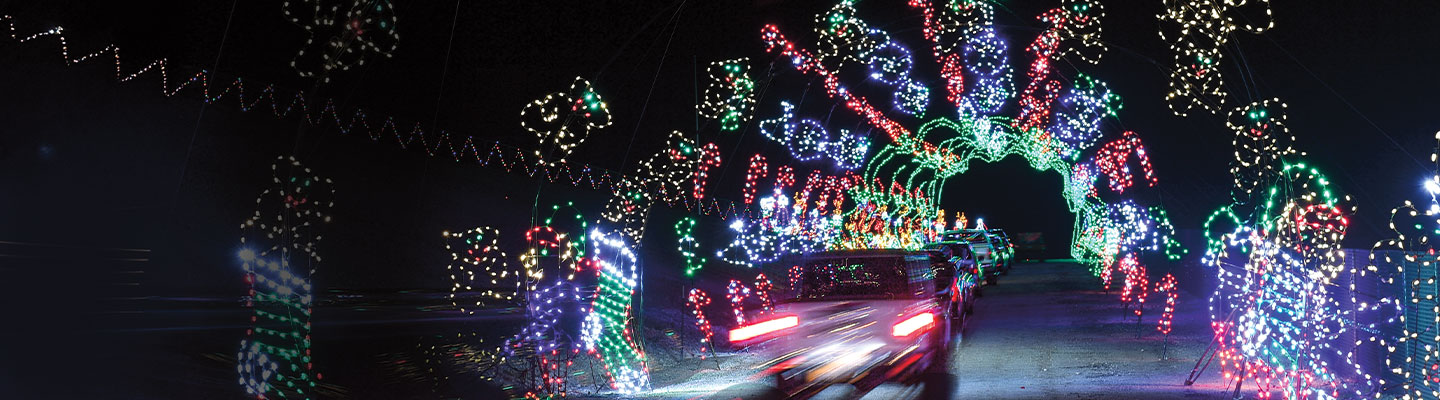

FESTIVE RIDE: Cars drive through a tunnel of lights at a holiday display in Nevada.

ETHAN MILLER/GETTY IMAGES

STANDARDS

NGSS: Core Idea: PS3.A, PS3.B, ETS1.B

CCSS: RST.4

TEKS: 6.8B, 6.5E, 7.5E, 8.5E, PHYS.6D

Standards

Drive-Through Light Show

During the holiday season, people are enjoying spectacular light displays from the comfort of their cars.

AS YOU READ, THINK ABOUT how electricity powers holiday lights.


For most of the year, fans can watch some of the world’s fastest race cars zip around the track at Circuit of The Americas in Austin, Texas. But during wintertime, the Circuit hosts a different type of driving experience. The sports facility transforms a 1.6 kilometer (1 mile)-long roadway next to the track into a dazzling, drive-through light display known as Peppermint Parkway. Vehicles packed with family and friends can cruise past giant candy canes, sparkling snowmen, a gingerbread house, and other holiday-themed decorations—all decked out in roughly 6 million colorful lights!

For most of the year, fans can watch races at Circuit of the Americas in Austin, Texas. Some of the world’s fastest race cars zip around the track. But in winter, the sports facility hosts a different driving experience. A 1.6 kilometer (1 mile)-long roadway lies next to the track. It becomes a dazzling drive-through light display known as Peppermint Parkway. Family and friends pack into their vehicles. They drive past giant candy canes, sparkling snowmen, a gingerbread house, and other holiday decorations. The display is covered in about 6 million colorful lights!

CIRCUIT OF THE AMERICAS

SWEET DISPLAY: A car passes a gingerbread house at Peppermint Parkway.

“Our biggest challenge with Peppermint Parkway is the limited amount of time we have to build it,” says Maggie Boyd, director of events at the track. The Formula 1 United States Grand Prix is held at the Circuit each October. After this championship race, a crew of installers and electricians has only a few weeks to get the parkway set up before the start of the holiday season in November.

Drive-through displays, like Peppermint Parkway, are growing in popularity across the U.S. Each light show adds its own festive touches to wow visitors. Some have synchronized music, video animations, costumed characters, carnival rides, and food. Science World spoke with some of the creators of Peppermint Parkway to find out what goes into making one of these electrifying holiday extravaganzas.

“Our biggest challenge with Peppermint Parkway is the limited amount of time we have to build it,” says Maggie Boyd. She’s the director of events at the track. The Formula 1 United States Grand Prix is held at the Circuit each October. After this championship race, installers and electricians get to work. The holiday season starts in November. So they have only a few weeks to set up the parkway.

Drive-through displays, like Peppermint Parkway, are getting more popular across the U.S. Each light show adds its own fun touches to wow visitors. Some include synchronized music, video animations, and costumed characters. They may have carnival rides and food. Science World spoke with some of Peppermint Parkway’s creators. They explained how they produce this electrifying holiday spectacle.

POWERING UP

Each year, Boyd’s team comes up with a layout for the parkway’s attractions. “We print a giant blank map of the route and hand draw where we want to set everything,” she says. They sketch out plans for the different sections, which have names like Candy Cane Lane and Gingerbread Alley. Then the team sends their designs to Premier Christmas, a company that installs large-scale holiday décor and lighting. Its employees figure out how to bring the sketches to life.

A team of about 10 professionals from Premier Christmas puts everything together. They run strings of lights back and forth to cover the ground and walls along the sides of the track before assembling decorations. The team uses stakes to secure large décor items, like oversized polar bears and presents, to the ground. They work up to 15 hours a day, seven days a week.

Each year, Boyd’s team creates a layout for the parkway’s attractions. “We print a giant blank map of the route and hand draw where we want to set everything,” she says. Different sections have names like Candy Cane Lane and Gingerbread Alley. The team sketches out plans for each one. Then they send their designs to Premier Christmas. This company installs large-scale holiday décor and lighting. Its employees find a way to bring the sketches to life.

About 10 workers from Premier Christmas put everything together. First, they run strings of lights back and forth. They cover the ground and walls along the track with them. Then they assemble decorations. Large décor items include oversized polar bears and presents. The team secures them to the ground with stakes. They work up to 15 hours a day, seven days a week.

CIRCUIT OF THE AMERICAS

HO-HO-HO: Dancing Santas at Peppermint Parkway wave goodbye to visitors.

As they work, the crew inspects each string of lights for damage. That’s because each light will turn on only if powered by an unbroken circuit—a closed path that electricity can flow through (see “How a Circuit Works”). “You’ve got to have a loop for the circuit to work,” says Justin Lubbers, owner of Premier Christmas. If a connection comes loose, the flow of electricity will stop at that point.

The crew is also careful not to connect too many strands of lights to the same circuit, since each can handle a limited amount of current—the movement of charged particles. As a safety measure, each circuit includes a device called a circuit breaker. It can interrupt the flow of electricity to prevent the circuit from becoming overloaded with too much current. “We work to ensure we’re not exceeding circuit breaker limitations,” says Lubbers. “If you trip the circuit breaker, then the lights don’t come on and nobody’s happy.”

The crew inspects each string of lights for damage as they work. Each light must be powered by an unbroken circuit, or it won’t turn on. A circuit is a closed path that electricity can flow through (see “How a Circuit Works”). “You’ve got to have a loop for the circuit to work,” says Justin Lubbers, owner of Premier Christmas. If a connection comes loose, the flow of electricity will stop there.

The crew is careful not to connect too many lights to the same circuit. Each circuit can handle a limited amount of current. That’s the movement of charged particles. As a safety measure, each circuit includes a device called a circuit breaker. It can interrupt the flow of electricity. That prevents the circuit from becoming overloaded with too much current. “We work to ensure we’re not exceeding circuit breaker limitations,” says Lubbers. “If you trip the circuit breaker, then the lights don’t come on and nobody’s happy.”

FLIPPING THE SWITCH

Up until a few decades ago, holiday lights used incandescent bulbs. Inside each bulb, electricity passes through a wire called a filament. “An incandescent bulb is just a wire that gets so hot that it glows,” says Rhett Allain, a physicist at Southeastern Louisiana University. Most electricity flowing to the bulb is lost as heat, wasting a lot of energy.

Today most string lights, like those used at Peppermint Parkway, contain more-efficient light-emitting diodes (LEDs). An LED bulb consists of two layers of semiconducting material that allow or resist the flow of electricity under different conditions. One layer contains extra electrons. When a current is applied, these negatively charged particles jump to the next layer, filling spaces where electrons are missing. As a result, energy is released as light.

A few decades ago, holiday lights used incandescent bulbs. Each bulb contains a wire called a filament. Electricity passes through it. “An incandescent bulb is just a wire that gets so hot that it glows,” says Rhett Allain. He’s a physicist at Southeastern Louisiana University. When electricity flows to the bulb, most is lost as heat. That wastes a lot of energy.

Today most string lights contain light-emitting diodes (LEDs). Peppermint Parkway uses these more efficient lights. An LED bulb has two layers of semiconducting material. They allow or resist the flow of electricity under different conditions. One layer contains extra electrons. When a current is applied, these negatively charged particles jump to the next layer. They fill spaces where electrons are missing. As a result, energy is released as light.

CIRCUIT OF THE AMERICAS

CANDY CANE LANE: A row of giant treats lines the route at Peppermint Parkway.

“You don’t really lose a lot of energy in that transition,” says Allain. “That makes them way more efficient than an incandescent bulb.” In fact, an LED uses 80 percent less energy and lasts much longer.

LED lights produce different colors depending on the semiconducting material they’re made of. Some can even change colors by mixing red, green, and blue light to produce different hues.

When the lights power up at Peppermint Parkway on opening night, cars line up to enter. There are tunnels of flashing lights, actors in costumes, and holiday music. “It’s magical for me to see the end result and to know how many people go through and enjoy it,” says Lubbers. “It’s amazing seeing the looks of awe and joy on everyone’s faces as they cruise through our mile-long display!” adds Boyd.

“You don’t really lose a lot of energy in that transition,” says Allain. “That makes them way more efficient than an incandescent bulb.” In fact, an LED bulb uses 80 percent less energy. It also lasts much longer.

LED lights can be made of different semiconducting materials. And these materials produce different colors of light. Some LEDs can even change colors. To do this, they mix red, green, and blue light.

On opening night, the lights power up at Peppermint Parkway. Cars line up to enter. There are tunnels of flashing lights, actors in costumes, and holiday music. “It’s magical for me to see the end result and to know how many people go through and enjoy it,” says Lubbers. “It’s amazing seeing the looks of awe and joy on everyone’s faces as they cruise through our mile-long display!” adds Boyd. 

DESIGNING SOLUTIONS: If you were to create a light-filled holiday display, what would it look like?

videos (1)
Skills Sheets (4)
Skills Sheets (4)
Skills Sheets (4)
Skills Sheets (4)
Games (1)
Lesson Plan (2)
Lesson Plan (2)
Text-to-Speech