

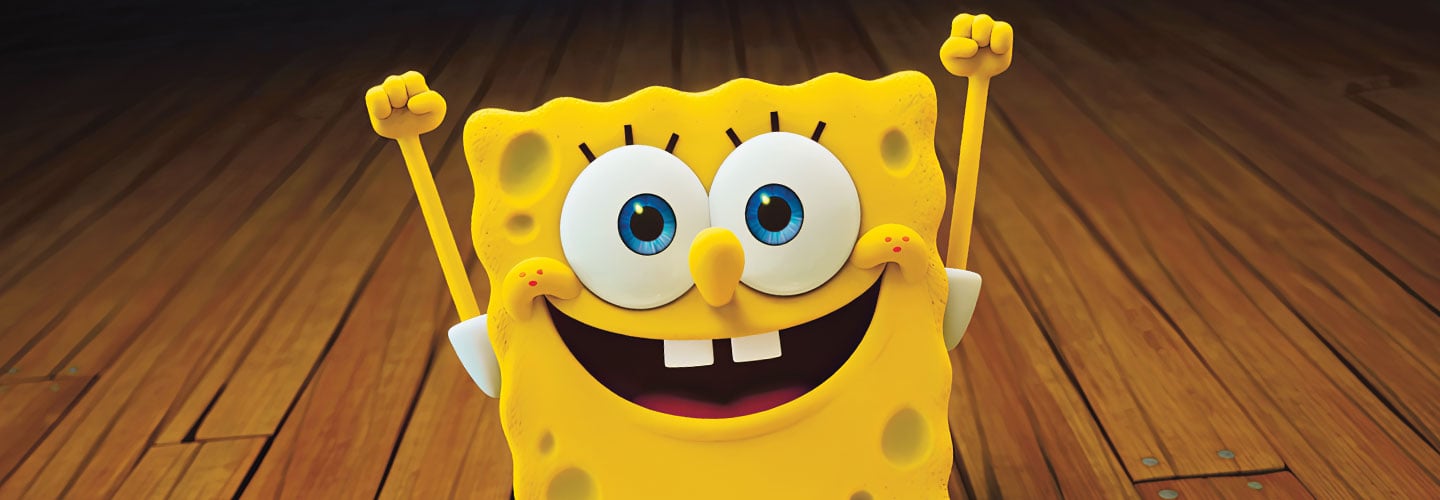

UNIQUE ABILITY: Like real sponges, SpongeBob has the ability to regrow parts of his body.

PARAMOUNT ANIMATION AND NICKELODEON MOVIES

STANDARDS

NGSS: Core Idea: LS1.A, ETS2.B

CCSS: RI.7

TEKS: 6.12B, 7.3B, 8.12C, AQUA.7A, AQUA.13B

Standards

Who Lives in a Pineapple Under the Sea?

The SpongeBob Movie: Search for SquarePants hits theaters on December 19. Let’s dive down to the underwater city of Bikini Bottom to learn about the real science behind some of the show’s colorful characters.

AS YOU READ, THINK ABOUT how characters from SpongeBob SquarePants compare with their real-life counterparts.

SPONGEBOB: YELLOW TUBE SPONGE

Before he worked in animation, SpongeBob SquarePants creator Stephen Hillenberg taught marine biology at the Ocean Institute in California. Hillenberg’s love of the ocean inspired him to create a show starring the weirdest marine animal he could think of: a sponge.

SpongeBob is an optimistic, imaginative goofball. “I love that charismatic little sponge,” says Kerri Olzewski, who manages animal habitats at Shedd Aquarium in Chicago. Real sponges don’t have quite so much personality. In fact, they are some of the most basic animals on Earth. They don’t have eyes, a mouth, or organs.

Stephen Hillenberg was the creator of SpongeBob SquarePants. Before he worked in animation, Hillenberg taught marine biology at the Ocean Institute in California. Hillenberg loved the ocean. That moved him to create a show about the weirdest marine animal he knew. It’s a sponge.

SpongeBob is a cheerful, imaginative goofball. “I love that charismatic little sponge,” says Kerri Olzewski. She manages animal habitats at Shedd Aquarium in Chicago. Real sponges don’t have so much personality. They are some of Earth’s most basic animals. They don’t have eyes, a mouth, or organs.

(C) FABIEN MICHENET/BIOSPHOTO

NOT-SO-SQUARE: Yellow tube sponges are found in coral reefs throughout the Caribbean Sea.

Sea sponges were once collected and used for scrubbing. But they don’t look like plastic, factory-made kitchen sponges. Living sponges come in a variety of shapes and sizes. Despite his rectangular body, SpongeBob is meant to be a yellow tube sponge.

In the cartoon, SpongeBob is constantly on the move, flipping burgers, jellyfishing, and practicing karate. In real life, sponges only swim freely in their larval, or immature, form. “Once they’re adults, they’ll find their rock, stick there, and hang out,” says Olzewski. These filter feeders remain attached to one spot for the rest of their lives. They pump water through their bodies, filtering out food to eat. In the process, they remove pollution from the water. This helps keep their environment clean. “What sponges lack in charisma they make up for in being super important for water quality,” says Olzewski. “They’re vital for their ecosystem.”

People used to gather sea sponges. They used them for scrubbing. But sea sponges don’t look like plastic, factory-made kitchen sponges. Living sponges have different shapes and sizes. SpongeBob has a rectangular body. But he’s meant to be a yellow tube sponge.

In the cartoon, SpongeBob is constantly on the move. He flips burgers, goes jellyfishing, and practices karate. Real-life sponges swim freely only in their larval form. That’s their immature stage. “Once they’re adults, they’ll find their rock, stick there, and hang out,” says Olzewski. They’re attached to one spot for the rest of their lives. These filter feeders pump water through their bodies. They filter out food to eat. They also remove pollution from the water. This helps keep their environment clean. “What sponges lack in charisma they make up for in being super important for water quality,” says Olzewski. “They’re vital for their ecosystem.”

PHOTO 12/ALAMY STOCK PHOTO

PATRICK: SEA STAR

BRENNA HERNANDEZ/SHEDD AQ/BLUE PLANET ARCHIVE

ROCK STAR: Sea stars typically have five points. Some species have up to 50!

Like many real-life sea stars, Patrick Star’s body has five points. His differs in one big way, though: “Where Patrick’s belly button is, that’s where his mouth should be,” says Olzewski. Real sea stars don’t have eyes either. Instead, their arms are lined with tube feet, which help the animals sense chemicals in their environment as they crawl along the sandy ocean floor.

Patrick loves to eat—the same is true for real sea stars. The creatures are tireless hunters. “That was the inspiration for Patrick,” said Hillenberg in a 2005 interview. “Sea stars seem kind of dumb and slow, but in reality, they are very active and aggressive.” In the cartoon, Patrick and SpongeBob are best friends. Unfortunately, their real-life counterparts would not get along as swimmingly. “Patrick would eat SpongeBob,” says Olzewski. “Sea stars are opportunistic. They will go after anything that they can find.”

Many real-life sea stars have five points. Patrick Star’s body does too. But his differs in one big way. “Where Patrick’s belly button is, that’s where his mouth should be,” says Olzewski. Real sea stars don’t have eyes either. Their arms are lined with tube feet. The animals crawl along the sandy ocean floor. As they travel, their tube feet sense chemicals in their environment.

Patrick loves to eat. So do real sea stars. The creatures are tireless hunters. “That was the inspiration for Patrick,” said Hillenberg in a 2005 interview. “Sea stars seem kind of dumb and slow, but in reality, they are very active and aggressive.” In the cartoon, Patrick and SpongeBob are best friends. In real life, these animals wouldn’t get along so well. “Patrick would eat SpongeBob,” says Olzewski. “Sea stars are opportunistic. They will go after anything that they can find.”

PHOTO 12/ALAMY STOCK PHOTO

MR. KRABS: CRAB

THOMAS MARENT/MINDEN PICTURES 

AYE, AYE, CRAB-TAIN: A ghost crab scuttles along a beach in Ecuador.

Mr. Krabs is the owner of the Krusty Krab, a fast-food joint made from an old lobster trap. He’ll do whatever it takes to make money, using his massive claws mainly to pinch pennies. Like sea stars, real crabs are very opportunistic. They’re also omnivores—they’ll eat both plants and animals.

Mr. Krabs is a crustacean. These creatures have a tough exoskeleton, or external skeleton. This rigid shell can become a tight fit as the animal grows. When a crab gets too big, it molts. It bursts out of its old exoskeleton, revealing a new, bigger one underneath. In one episode of SpongeBob, Mr. Krabs molts unexpectedly. Afterward, he looks pink and squishy. That’s because his new shell needs time to harden—just like a real crab’s!

Mr. Krabs owns the Krusty Krab. This fast-food joint is made from an old lobster trap. He’ll do anything to make money. His massive claws mainly pinch pennies. Like sea stars, real crabs are very opportunistic. They’re also omnivores. They’ll eat both plants and animals.

Mr. Krabs is a crustacean. These creatures have a tough exoskeleton, or external skeleton. This rigid shell becomes tight as the animal grows. When a crab gets too big, it molts. It bursts out of its old exoskeleton. A new, bigger one is underneath. Mr. Krabs suddenly molts in one SpongeBob episode. Then he looks pink and squishy. That’s because his new shell needs time to harden. So does a real crab’s!

PARAMOUNT+/NICKELODEON/COURTESY EVERETT COLLECTION

PLANKTON: CYCLOPS COPEPOD

SCENICS & SCIENCE/ALAMY STOCK PHOTO

ALL HAIL PLANKTON: Copepods are found in nearly every watery environment, from freshwater ponds to the deep ocean.

Compared with other citizens of Bikini Bottom, Plankton is incredibly tiny. In real life, he would be less than 2 millimeters (0.08 inches) long. He’s a cyclops copepod. These little crustaceans have two long antennae and a single red eye. Many species of copepod are plankton—aquatic organisms that drift in the water because they’re too small to swim against ocean currents.

Plankton is the cartoon’s main villain, terrorizing Bikini Bottom with his evil schemes. But in real-life ecosystems, “he’s actually extremely necessary,” says Olzewski. “If there were no plankton, almost all other life in the ocean would cease to exist.” Plankton are a primary food source for almost all sea creatures, including sponges and crabs! “In the real world, everything eats plankton,” says Olzewski. “That might be why he’s so upset all the time, just knowing he’s at the bottom of the food chain.”

Plankton is much smaller than other citizens of Bikini Bottom. In real life, he would be less than 2 millimeters (0.08 inches) long. He’s a cyclops copepod. These are little crustaceans. They have two long antennae and a single red eye. Many copepod species are plankton. These aquatic organisms are too small to swim against ocean currents. So they drift in the water.

Plankton is the cartoon’s main villain. His evil schemes terrorize Bikini Bottom. But in real-life ecosystems, “he’s actually extremely necessary,” says Olzewski. “If there were no plankton, almost all other life in the ocean would cease to exist.” Plankton are a main food source for most sea creatures. That includes sponges and crabs! “In the real world, everything eats plankton,” says Olzewski. “That might be why he’s so upset all the time, just knowing he’s at the bottom of the food chain.”

MAXIMUM FILM/ALAMY STOCK PHOTO

SQUIDWARD: GIANT PACIFIC OCTOPUS

SHUTTERSTOCK.COM

ARMED AND READY: A giant Pacific octopus swimming in the Pacific Ocean

Despite his name, Squidward Tentacles is not a squid—he’s an octopus. You can tell because he has a large, round head. Squids’ heads are more triangular. So why is the character called Squidward? Because, according to Hillenberg, it sounded funnier than a name like “Octoward.”

Octopuses and squid are both cephalopods—a group of marine animals with squishy bodies and long arms. Octopuses have eight arms. (According to the show’s animators, Squidward has only six arms because it made him easier to draw.) Each arm is covered with hundreds of suction cups that can feel, taste, and latch on to surfaces. These limbs operate independently. That’s because they each contain their own miniature brain!

Squidward is a giant Pacific octopus—the largest species of octopus on Earth. They grow to 4.9 meters (16 feet) across on average! “Squidward seems to be highly intelligent—that’s right on track for this species,” says Olzewski. Giant Pacific octopuses are incredibly smart, she says. They can solve complex puzzles and mazes, twist open jars, and recognize individual humans.

His name is Squidward Tentacles, but he’s not a squid. He’s an octopus. How can you tell? He has a large, round head. Squids’ heads are more triangular. So why is the character called Squidward? Hillenberg thought it sounded funnier than a name like “Octoward.”

Octopuses and squid are both cephalopods. These marine animals have squishy bodies and long arms. Octopuses have eight arms. (Squidward has only six arms. The show’s animators say he was easier to draw that way.) Each arm is covered with hundreds of suction cups. They can feel, taste, and latch on to surfaces. These arms operate independently. Each one contains its own miniature brain!

Squidward is a giant Pacific octopus. That’s the largest species of octopus on Earth. They grow to 4.9 meters (16 feet) across on average! “Squidward seems to be highly intelligent—that’s right on track for this species,” says Olzewski. Giant Pacific octopuses are incredibly smart, she says. They can solve complex puzzles and mazes and twist open jars. And they can recognize individual people.

CONSTRUCTING EXPLANATIONS: Pick a character described in the article. Compare and contrast the cartoon animal with its real-life counterpart. How are they similar? How are they different?

videos (1)
Skills Sheets (4)
Skills Sheets (4)
Skills Sheets (4)
Skills Sheets (4)
Lesson Plan (2)
Lesson Plan (2)
Text-to-Speech